


- Beranda
- Berita Luar Negeri
Authorities Cracking Down on Daoist Temples and Practices
...


TS
.haiyaa
Authorities Cracking Down on Daoist Temples and Practices
Authorities kracking Down on Daoist Temples and Practices
The suppression directly affects the foundation of one of the “three teachings” of traditional Chinese spirituality and religion, along with Confucianism and Buddhism.
As Bitter Winter has previously reported, authorities have damaged and destroyed statues of Laozi, who is considered to be the founder of Daoism. Multiple Daoist temples across regions are being kracked down on, with authorities banning religious activities, like the burning of incense.
Hin Temple, a Daoist temple in Fang county, under the jurisdiction of Shiyan city in central Hubei Province, is among them.
Even though the Hin Temple was designated, by government approval in December 1993, a major historical and cultural site, protected at the provincial level. As a result, its religious activities have always thrived, and the site saw thousands of visitors daily.
But now the Chinese Communist Party (CCP) has decided it’s over this. On September 20, 2018, the Fang county government convened a meeting in which they said burning incense for prayer is a superstitious activity that pollutes the environment and called for it to end. Authorities even ordered the head of the Hin Temple to purge the temple of all articles related to religious activities and forbade Daoist priests from wearing their attire.
The Daoist priests were forced to acquiesce. The head of the temple expressed that the priests who had considered the temple their home for decades felt dispirited and left; those who have remained behind have become the temple’s custodians, guarding the place.
A county official said the temple krackdown movement is similar to the Cultural Revolution, and that authorities are relying on units, including Religious Affairs Bureau, People’s Procuratorate, Organization Department and Public Security Bureau to enforce it. If Daoist government officials are discovered burning incense, they will be handed over to the Organization Department – civilians caught burning incense will be turned over to the Public Security Bureau.
“The Communist Party is just a revolutionary party. If anyone doesn’t listen to them, they’ll ‘revolutionize’ them,” one Daoist pilgrim said. “Who would dare not to obey?”
In Gaolan county, under the jurisdiction of Lanzhou city, in China’s northwest Gansu Province, the Baiyi Temple has also faced similar persecution.
Under the pretext of “promotion of folk construction and the elimination of outmoded conventions,” authorities in October 2018 ordered the head of Baiyi Temple to lock up the main hall of the temple and hand over the keys,” an inside source said.
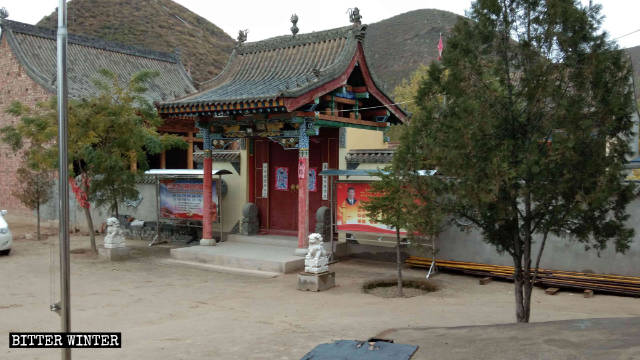
A pole for the national flag and a bulletin board with the “four requirements” have been placed outside the Baiyi Temple.
Now, the temple is prohibited from admitting strangers, who are effectively banned from practicing their religion, meaning they can’t burn incense and joss paper offerings, chant scripture or light candles. Adding insult to injury: The temples are being forced to hang up portraits of Mao Zedong and the national flag while being forced to install surveillance cameras.
The same krackdown on Daoist temples is spreading across central Henan Province. In September 2018, a government official from Cijian town, a division of Xin’an county under the jurisdiction of Henan’s Luoyang city, informed the head priests of four local temples, including the Founding Father’s Temple and Jade Emperor Temple, that the town had convened and decided they wouldn’t be allowed to burn incense anymore; the official also ordered the head priests to hand over the keys to their temples within three days.
Coerced by government pressure, the head priests helplessly handed over their keys, and, in accordance with the government’s demands, took down their temple signboards, destroyed their incense burners, took down their Daoist flags and in its place raised the national flag.
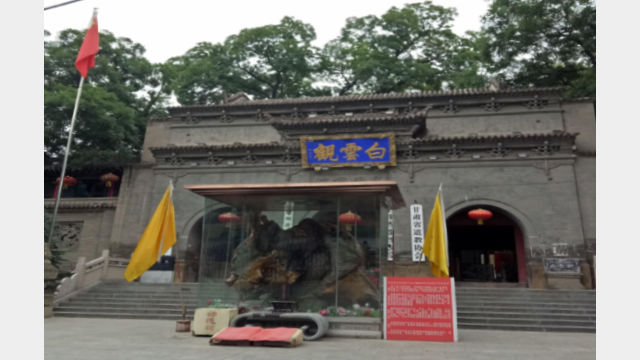
The national flag is raised in front of the Baiyun Temple.
haiyaaa ciilaaka wuuthuutt waaa
Akhir nyeee Land of SICK and RETARD sadar Asep Dupa sumber Kebodohan waaa!!!!
Chicombot bingung waaa
The suppression directly affects the foundation of one of the “three teachings” of traditional Chinese spirituality and religion, along with Confucianism and Buddhism.
As Bitter Winter has previously reported, authorities have damaged and destroyed statues of Laozi, who is considered to be the founder of Daoism. Multiple Daoist temples across regions are being kracked down on, with authorities banning religious activities, like the burning of incense.
Hin Temple, a Daoist temple in Fang county, under the jurisdiction of Shiyan city in central Hubei Province, is among them.
Even though the Hin Temple was designated, by government approval in December 1993, a major historical and cultural site, protected at the provincial level. As a result, its religious activities have always thrived, and the site saw thousands of visitors daily.
But now the Chinese Communist Party (CCP) has decided it’s over this. On September 20, 2018, the Fang county government convened a meeting in which they said burning incense for prayer is a superstitious activity that pollutes the environment and called for it to end. Authorities even ordered the head of the Hin Temple to purge the temple of all articles related to religious activities and forbade Daoist priests from wearing their attire.
The Daoist priests were forced to acquiesce. The head of the temple expressed that the priests who had considered the temple their home for decades felt dispirited and left; those who have remained behind have become the temple’s custodians, guarding the place.
A county official said the temple krackdown movement is similar to the Cultural Revolution, and that authorities are relying on units, including Religious Affairs Bureau, People’s Procuratorate, Organization Department and Public Security Bureau to enforce it. If Daoist government officials are discovered burning incense, they will be handed over to the Organization Department – civilians caught burning incense will be turned over to the Public Security Bureau.
“The Communist Party is just a revolutionary party. If anyone doesn’t listen to them, they’ll ‘revolutionize’ them,” one Daoist pilgrim said. “Who would dare not to obey?”
In Gaolan county, under the jurisdiction of Lanzhou city, in China’s northwest Gansu Province, the Baiyi Temple has also faced similar persecution.
Under the pretext of “promotion of folk construction and the elimination of outmoded conventions,” authorities in October 2018 ordered the head of Baiyi Temple to lock up the main hall of the temple and hand over the keys,” an inside source said.
A pole for the national flag and a bulletin board with the “four requirements” have been placed outside the Baiyi Temple.
Now, the temple is prohibited from admitting strangers, who are effectively banned from practicing their religion, meaning they can’t burn incense and joss paper offerings, chant scripture or light candles. Adding insult to injury: The temples are being forced to hang up portraits of Mao Zedong and the national flag while being forced to install surveillance cameras.
The same krackdown on Daoist temples is spreading across central Henan Province. In September 2018, a government official from Cijian town, a division of Xin’an county under the jurisdiction of Henan’s Luoyang city, informed the head priests of four local temples, including the Founding Father’s Temple and Jade Emperor Temple, that the town had convened and decided they wouldn’t be allowed to burn incense anymore; the official also ordered the head priests to hand over the keys to their temples within three days.
Coerced by government pressure, the head priests helplessly handed over their keys, and, in accordance with the government’s demands, took down their temple signboards, destroyed their incense burners, took down their Daoist flags and in its place raised the national flag.
The national flag is raised in front of the Baiyun Temple.
haiyaaa ciilaaka wuuthuutt waaa
Akhir nyeee Land of SICK and RETARD sadar Asep Dupa sumber Kebodohan waaa!!!!
Chicombot bingung waaa



anasabila dan 2 lainnya memberi reputasi
3
1.4K
14

Komentar yang asik ya
Mari bergabung, dapatkan informasi dan teman baru!

Berita Luar Negeri
81.9KThread•19.7KAnggota
Tampilkan semua post
TS
.haiyaa
#3
Quote:
haiyaaa ciilaaka luuwa weelas waaa
Ane magh cuman bawain FAKTA bahwa SICKmen of Asia rata2 ng*he,klo Ente merasa sama2 SUB-human kek mereka yaaa hak Ente laaa!!!

Ane bukan si Ah Yan,gak perlu ngarang2 pake Fake News waaa
https://bitterwinter.org/authorities...and-practices/
Ng*he Kakus forum cib*y,Links yg bener adalah bitterwinter.org/authorities-kracking-down-on-daoist-temples-and-practices/,tapi letter C diganti jd K ama Programmer Kakus yg bego waaa!!!!
Ya udeh ane kasih Bonus biar yakin bahwa Emperor Xi bilang endusin Asep Dupa bikin org jd bodoh waaa!!!!
Ancient Buddhist Temple Suppressed in Shanxi Province
Authorities are harassing a once flourishing, more than 1,000-year-old temple and subject monks to increased control and indoctrination.
Feng Gang
In the current climate of religious persecution in China, even the venues of worship that had been approved by the Chinese Communist Party (CCP) are being persecuted. One such example is Shengquan Temple (聖泉寺), a more than a thousand-year-old ancient temple located in Xinxing village in the suburb of Yangquan city in north China’s Shanxi Province. The temple that was once the center of local Buddhist activities, under suppression by the CCP authorities, is witnessing a gradual decline and faces closure.
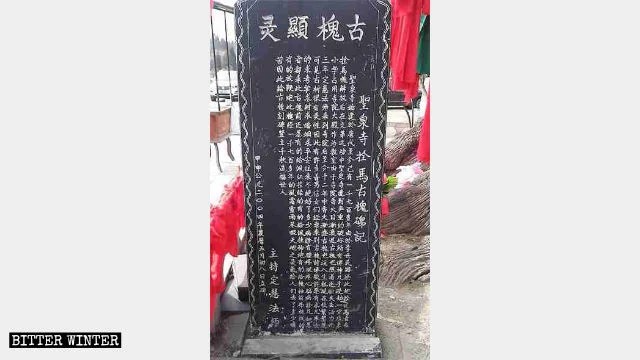
An inscribed tablet details the history of Shengquan Temple.
Shengquan Temple was built during the rule of Tang dynasty, spanning the 7th to 10th centuries. It was severely damaged during the Cultural Revolution, and almost all of the statues inside the temple were taken away. After Venerable Dinghui became the abbot of Shengquan Temple in 1993, he led the monks at the temple to raise funds, with which they repaired the temple and expanded its building complex, at a total cost of over 30 million RMB (more than $4.4 million), and the number of monks increased to over 100. As Venerable Dinghui went around giving lectures to promote the teachings of Buddhism, more and more worshippers flocked to the temple, and it increasingly flourished.
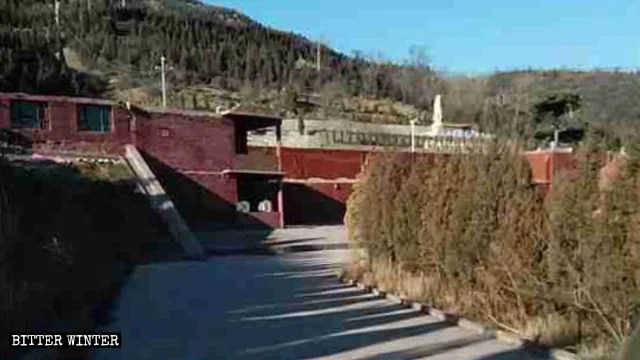
A two-story building of the Shengquan Temple has now been demolished.
However, starting in 2017, the local Religious Affairs Bureau demanded that the temple reduce its scale, and ordered the demolition of its buildings. The next year, the Bureau successively demolished three buildings from the temple’s expanded complex under the pretext that they were of “substandard quality,” leaving behind only the small pre-expansion temple. Most of the resident monks were evicted from the temple, and an 18-meter-tall Buddha statue inside the temple was removed. Due to the demolition, the statues that were once inside had nowhere to be moved, so they were abandoned under the eaves of the destroyed buildings of the temple’s expanded complex.
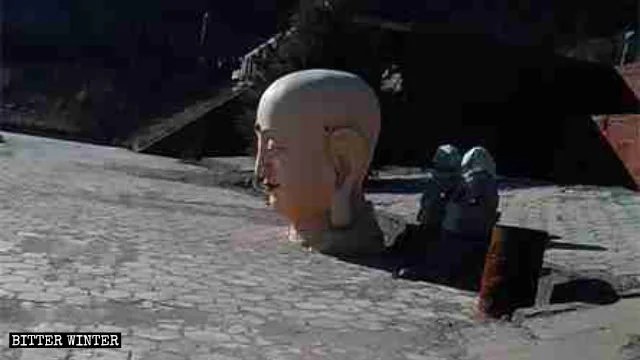
The 18-meter-tall Buddha statue was destroyed, with only the statue’s head left behind in the yard.
According to an observer who follows the status of religious freedom in China, the fact that the Chinese government often cites reasons like “substandard quality” or “inadequate fire control measures” to shut down or demolish places of worship is used to justify and “legalize” its religious suppression and it’s an attempt to cover up the truth behind it.

A Buddhist who requested anonymity told Bitter Winter that the authorities’ suppression of the temple extends far beyond demolishing its buildings. The authorities are also seeking to strengthen the ideological transformation of the temple’s monks.
He revealed that the temple’s current abbot, Yizhao, who succeeded Venerable Dinghui in 2014 by the CCP’s appointment, has fully cooperated with the authorities’ forced demolition policy. He was quoted as saying that regardless of where one is, the Party must always come first. According to the new abbot, disobeying the Party is tantamount to rebellion; even when worshipping Buddha, one must first thank the Party.
The Buddhist told Bitter Winter that the abbot once said that monks should not be too superstitious. “You all say that believing in Buddha can keep you safe, but has it saved you? Not at all! Having the Party and the state is sufficient,” the Buddhists quoted Abbot Yizhao.
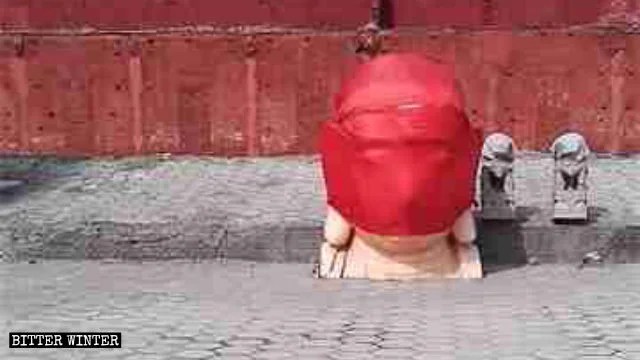
The head of a demolished Buddha statue is wrapped in red cloth.
Assisted by the new abbot, the CCP is successfully “sinicizing” the temple. Yangquan city’s Religious Affairs Bureau often requires the temple’s monks to transcribe the Party rules and various government documents, which are then submitted by the abbot to the China Buddhist Association. Officials also conduct assessments of the temple’s monks at irregular intervals.
One local Buddhist said, “The temple is managed by the state now. Whenever Religious Affairs Bureau officials come for an inspection, these monks are forced to study [the CCP’s policies]. There is nothing they can do about it. Monks are supposed to recite Buddhist scriptures and worship Buddha, but now, they are forced to recite government documents and worship the Communist Party.”
He added, “The government always finds many excuses in kracking down on religion, but the essence always remains the same: The authorities’ ultimate goal has always been to make religion disappear.”
Diubah oleh .haiyaa 09-04-2019 13:07
0
Tutup