


- Beranda
- Help, Tips & Tutorial Music
[UPDATE] NEWs Recording Gear
...


TS
PublicEnemy
[UPDATE] NEWs Recording Gear
Diubah oleh PublicEnemy 03-04-2018 16:48
0
878
4

Komentar yang asik ya
Mari bergabung, dapatkan informasi dan teman baru!

Help, Tips & Tutorial Music
3.9KThread•2.1KAnggota
Tampilkan semua post
TS
PublicEnemy
#2
23 of the best affordable studio monitor speakers
find your perfect pair for between £100 and £500
Listen up
You might think that you don’t need another set of speakers. The chances are that you’ve already got a pair hooked up to your computer - in the MP3 age, this might even be your main hi-fi setup - or maybe you do all of your listening on headphones.
When it comes to making music, though, a decent pair of studio monitor speakers is, if not essential, a very wise investment. To understand why, you need to understand how they work.
While your hi-fi or computer speakers are specifically designed to ‘flatter’ your music so that it sounds good, they typically do this in a way that could be considered unnatural. This isn’t a problem if you’re listening to someone else’s album, but when your goal is to create balanced mixes that will sound good on lots of different systems, it can be an issue.
Step forward the studio monitor speaker, which is designed to portray your music as it actually is rather than how your ears might want it to sound. We’re not going to delve too far into why these speakers are technically different, but the bottom line is that, if you mix your music through built-for- purpose monitors, you’ve got a far better chance of making it sound good.
Headphones are another issue altogether. Trying to create a balanced stereo mix while you’re monitoring through cans is notoriously difficult because, rather than hearing some of each channel (left and right) in each ear, it’s an ‘either/or scenario’. We wouldn’t dream of telling you not to use headphones at all - in many cases, such as when you’re making music on the move or at a time when making noise is a no-no, they’re essential - but it’s certainly a bad idea to rely on them exclusively.
It would be easy to generalise and say that the more you pay for your monitors, the ‘better’ they’ll sound. This is true up to a point, but speaker preference is ultimately a very personal thing so, if at all possible, we’d advise you to try and audition a few sets before you make a decision.
Based on the reviews on MusicRadar (and in roughly ascending street price order), here are some of the best affordable studio monitors currently available.
![kaskus-image]()
Mackie CR3
These 50W powered monitors deliver a large sound through their 3-inch polypropylene-coated woofers and .75-inch ferrofluid-cooled silk-dome tweeters, with a frequency crossover of 3kHz.
They have the 'one active, one passive' arrangement tbat's standard for monitors of this size and price, with the added bonus of being able to switch the powered side to either the left or right.
The sound is detailed, but the top-end can get a bit swallowed up by the bass extension courtesy of the rear-facing ports. There are no attenuation controls to cope with EQing and room placement but, at this price, it's a small grumble.
4.5 out of 5
![kaskus-image]()
M-Audio AV42
The AV42 from M-Audio is an updated monitor that succeeds the popular AV40. In terms of specs and looks, it's very similar.
The AV42s still feature a 4-inch driver, 1-inch tweeter and 20 Watts of output. However, the grilles have been ditched for a cleaner design, with the main difference being the new 'OptImage IV tweeter wave guide'.
Running them alongside the Mackie CR3s, the AV42s have a slightly more detailed low-end courtesy of the larger driver. They are not as powerful as the Mackies on paper, but you won't notice the difference unless you are cranking up the volume to uncomfortable levels.
We wouldn't suggest these monitors for critical mixing responsibilities, but the AV42s perform admirably in the small-factor stakes, proving once again that the 'multimedia' label shouldn't always put you off.
4 out of 5
![kaskus-image]()
M-Audio BX5 D3
The BX5 has established itself as a reliable and affordable compact two-way monitor, maintaining its popularity through a number of updated and restyled versions.
Its latest incarnation carries through many common features from recent editions, including a one-inch silk-domed tweeter, five-inch woven Kevlar woofer (both magnetically-shielded) and vinyl laminated MDF cabinet.
Once again it uses a rear ported design to improve bass extension, and further rear panel elements include Volume control, XLR and TRS jack inputs and three Acoustic Space bass settings (Flat, -2dB and -4dB) to help compensate for the monitor position in the room. Much like the recent BX5 Carbon, you can connect both XLR and jack inputs simultaneously.
Overall, the BX5 D3 is a solid, compact performer with some useful features. And with its reliable sound, it's one of the best compact affordable monitors out there.
4.5 out of 5
![kaskus-image]()
Fluid Audio F5
These compact powered monitors feel light but solid. The rear panel sports a finned amplifier with power inlet/switch below and line inputs above (XLR, TRS and RCA). The rigid plastic front baffle centre houses the silk dome tweeter (in waveguide), coated paper composite woofer, volume trim fader and slot-shaped bass reflex port.
Without a doubt, the F5s deliver performance beyond their price point. Good transient response, a smooth mid to HF range and some punchy power make them good candidates if you have a small budget.
The slightly bulbous low-end isn't marred by any overt resonant peaks, but is something you'll have to get used to. Ultimately, though, the F5s give you a lot of speaker for your money.
4 out of 5
![kaskus-image]()
Tascam VL-S5
At 10 inches high, the VL-S5 is a compact monitor, and with a footprint of around 7 x 8 inches, is eminently suitable for placement, with tweeters at ear level, either side of your computer in a close-working environment.
There's 30 Watts of power driving the 1-inch silk dome tweeter and 40 Watts for the low-end's 5.25-inch Kevlar cone woofer. The crossover frequency between the two has been set at 3.2kHz - a little higher than some rival manufacturers' - to avoid phase distortion in the critical midrange area.
The only control, besides the on/off switch, is a volume knob that has no notches, and connectivity is via a balanced XLR or TRS jack.
Tascam has come up with something that's really rather good with the VL-S5. A pair of these would be a very good practical choice if you do not have a lot of space to place monitors in but still want good quality sound.
A smaller version, the VL-S3, also represents excellent value for money.
4 out of 5
![kaskus-image]()
Yamaha HS series
The HS5 and HS8 appear to be direct replacements for the HS50M and HS80M - the 5s and 8s referring to the size of their LF drivers in inches. The HS7 is positioned between the two, being equipped with a 6.5-inch LF driver (we guess H7 sounds sexier than H6.5).
Now, to many of us, the HS series look is very familiar, that white LF driver being highly reminiscent of the passive NS-10 family, discontinued some time ago and ubiquitous in professional studios since it was first launched back in the 1980s.
That look is no coincidence; the original NS-10 designer was involved here, and Yamaha is keen to promote the idea of a family lineage, saying that the HS series shares the same design philosophy. They seem to have got it spot on.
Reproducing a wide variety of music and various individual instruments, the HS monitors offer plenty of clarity, nice depth of field and a good sense of stereo positioning. The frequency response seems well-balanced, with nothing missing and nothing overtly hyped and, for a small nearfield, the bottom end is defined in a way that should give you a decent reading of the foundations of your track.
If you want more emphasis on the bottom end, or are looking to put together a 5.1 surround system, you can add the HS8S subwoofer to the setup, which brings a further 150 watts of low-end power.
4.5 out of 5
![kaskus-image]()
IK Multimedia iLoud Micro Monitor
IK Multimedia thinks it has a solution for those who want to take a compact yet high-quality set of monitors on the road, and it's called the iLoud Micro Monitor.
Appearance-wise, the speakers have an appealing 'roundness' to them, and are reassuringly weighty, though they're certainly small and light enough to be carried around. There's a cable connection between the two of them, with the left-hand speaker housing all the controls and connectivity options.
There are both TRS 1/8-inch and RCA inputs, while controls comprise a rear-mounted volume knob, EQ switches and a Bluetooth pairing button.
Each speaker housing contains a 3/4-inch tweeter, 3-inch woofer and bass reflex port, and we're promised 50W RMS with bass response down to 55Hz. The Micros are certainly loud enough for small project studio use - almost surprisingly loud, given their diminutive size - and, based on our tests, do a decent job of delivering the uncoloured, flat frequency response that they promise, with plenty of detail across the range and only a slight hint of boominess in the bottom end.
It may turn out to be the case that the iLoud Micro Monitor is most commonly bought as a second set of monitors; a setup that can be moved around easily and also one that can provide a different perspective on a mix. That said, if your main studio setup comprises little more than the corner of your living room, they're certainly worth considering as a main monitor, too.
4.5 out of 5
![kaskus-image]()
Behringer Truth B1031A
Behringer is a company that’s built its reputation on producing usable products at bargain prices, and the B1031As are a perfect example of this philosophy. They don’t look or sound cheap, but the price is very attractive indeed.
The all-important bass sounds tight and doesn’t distort, while the top end of the mix is nicely detailed without being too sharp. There monitors provide plenty of detail in the midrange, too - it’s not difficult to pick out the different instruments in your mix.
The B1031As have a nice wide sweet spot, meaning that you don’t need to worry about positioning yourself too precisely in front of them. They’re comfortable to listen to for long periods, too - these are speakers that you’ll be happy to live with and come at a great price.
4 out of 5
![kaskus-image]()
Fluid Audio FX8
The FX8 is the largest studio monitor in the Fluid Audio range and a departure from its usual two-way design that features a tweeter above the bass driver. Here, we're looking at a bi-amped dual concentric (also known as coaxial) design.
There are no tonal controls at all to adjust - just a volume control, and that is placed on the fascia for easy access and runs from silence up to 0dB, with an indented position at -6dB. Connectivity covers all the common options, with XLR, 1/4-inch jack and RCA phono sockets.
In use, there's a very good sense of sound location across the stereo spread, as well as a decent sense of space back to front. Clarity of sound is also very good across the frequency range, and the 8-inch woofers, combined with the bass reflex port, will give you plenty of bottom-end.
As with any monitor, it's a matter of getting familiar with the sound but, overall, we feel that the FX8s are monitors that we would have no trouble using on critical mixes.
4 out of 5
![kaskus-image]()
Adam F5/F7
The F5 and F7 use 5- and 7-inch woofers respectively. These are a new design combining glass fibre and a paper backing. The tweeters, meanwhile, use Adam's X-ART design.
Both models include the same rear panel controls, which are two +/- 6dB shelving EQs at 300Hz and 5kHz and a volume control (-inf to +6dB). There's also an 80Hz high-pass filter designed primarily for using with the optional F-Sub. Inputs are via either a phono or combination jack/XLR.
Fire up these monitors and they immediately sound just as you would expect: open in the top end with plenty of upper-mid detail; solid in the low mid and mid range and reasonably well balanced at the bottom.
The F7 sounds more expansive and engrossing, while the F5 is a bit more precise, particularly in the mid range. At the bottom, the F7 extension is much better.
On balance we prefer the F7s, mostly because the scale of the delivery is bigger and they sound more capable at high levels. That said, the F5 would be great for smaller rooms.
4.5 out of 5
![kaskus-image]()
Fostex PX-6
The PX-6 is a powered two-way nearfield monitor that is equipped with totally new 6.5-inch LF and 1-inch HF drivers and features extensive onboard DSP.
With 50 watts driving the low-end and 28 watts driving the top, the PX-6s should be plenty loud enough for a small/medium sized room. The DSP certainly seems to be doing its stuff when it comes to imaging, as everything seems pinpoint accurate and precise across the stereo field.
Sonically, there are no nasty surprises. The overall spread of frequencies seems naturally balanced, with nothing unduly emphasised or lacking, and the top-end adjustment is tastefully engineered to brighten things or subdue them slightly to suit your preferences.
4 out of 5
![kaskus-image]()
JBL Series 3 LSR308
Not only does the LSR308 feature two 56 Watt class D amps, but it also contains an ample 8-inch low-frequency driver. Throw in JBL's patented Slip Stream low-frequency port and you end up with some serious low-end action.
Build quality is good for a monitor in this price bracket, and it's pretty light when you consider its size. You have the choice of XLR and 1/4-inch jack inputs, both of which are balanced. There are also handy low- and high-frequency trim controls, which allow adjustments to be made in problem spaces.
All in all, the LSR308s represent excellent value for money and deliver a sound that is truly larger than life. They would be ideal for someone who's looking for something with a good deal of low-end extension and the ability to go a little louder than other monitors.
4 out of 5
![kaskus-image]()
KRK Rokit 8 G3
Designed and engineered in the USA but made in China, the Rokit 8 (RP8), the largest of the three two-way models in KRK's Rokit series is now in its newly-released third generation. This brings (among other things) an upgraded amplifier and tweeter and the inclusion of low frequency adjustment.
The RP8 offers XLR, 1/4-inch jack and RCA phono inputs. Another thoughtful touch is that the cabinets come fitted with a foam pad on their base to decouple them from whatever surface they are standing on.
This is a punchy monitor with a smooth top end, but most apparent is the solid and powerful bass performance. Once you've familiarised yourself with their sound, these are very capable speakers.
4 out of 5
![kaskus-image]()
Fostex PM641
The PM641 is a three-way monitor and has the mid-range driver and tweeter sitting next to each other on a horizontal axis above the woofer. This serves to minimise the physical height of the enclosure box.
The rear of each cabinet is dominated by a large finned heat-sink adjacent to the connection sockets, which are an XLR and a 1/4-inch TRS jack. There’s also a pair of three-way switches to change the response.
Performance-wise, the bass end is impressive and kick drums come fat and rounded. We'd describe the mids and top-end as ‘smooth’ - there's no hype or harshness here - and it feels like you could use these on long sessions without fatigue.
The PM641s might cost more than some of the budget options, but just shy of £400 is not a bad price to pay for a nicely practical three-way monitoring system.
4 out of 5
![kaskus-image]()
PreSonus Eris E8
The E8 is quite a large nearfield monitor and is bi-amped. The 8-inch Kevlar low-frequency transducer is driven by a 75-watt class AB amp, while the 1.25-inch silk-dome high-frequency tweeter gets 65W of class AB amplification. Besides the woofer and tweeter there's a horizontal front port.
All connections and controls reside on the rear panel. You should have no trouble getting a signal into the E8 as there are XLR, balanced TRS jack and unbalanced RCA (phono) sockets. Besides the necessary input gain knob, the E8 has a range of controls for tweaking the sound.
In use, the clarity of these monitors is good, and the overall balance of frequencies is one that you can work with. The top end comes through prominently and clearly (revealing the detail), while the bottom end is tight and focussed.
We'd be happy to use the E8s to mix our tracks; they can sound pretty big considering their compact cabinet. This is a monitor that should fit tidily into most rooms and will let you hear the detail in your mixes.
4 out of 5
![kaskus-image]()
Genelec 8010A
The 8010A is the smallest of Genelec's 8000 bi-amplified monitors, but you might be taken aback by how large these little speakers sound.
The low-frequency response is particularly impressive, while at the top end the 8010As possess a smooth characteristic that's accurate and free from hyping. With a monitor of this size we would expect a harshness in the highs and upper-mids, but that is not in evidence here at all, and the mid frequencies are well balanced and accurate.
There is enough scope for response adjustment to suit any number of mounting situations, from desktops to stands, and there's plenty of power, too. If you want a high-quality monitor that's both portable and durable, you might just have found it.
4.5 out of 5
NEXT: 17-End
find your perfect pair for between £100 and £500
Listen up
You might think that you don’t need another set of speakers. The chances are that you’ve already got a pair hooked up to your computer - in the MP3 age, this might even be your main hi-fi setup - or maybe you do all of your listening on headphones.
When it comes to making music, though, a decent pair of studio monitor speakers is, if not essential, a very wise investment. To understand why, you need to understand how they work.
While your hi-fi or computer speakers are specifically designed to ‘flatter’ your music so that it sounds good, they typically do this in a way that could be considered unnatural. This isn’t a problem if you’re listening to someone else’s album, but when your goal is to create balanced mixes that will sound good on lots of different systems, it can be an issue.
Step forward the studio monitor speaker, which is designed to portray your music as it actually is rather than how your ears might want it to sound. We’re not going to delve too far into why these speakers are technically different, but the bottom line is that, if you mix your music through built-for- purpose monitors, you’ve got a far better chance of making it sound good.
Headphones are another issue altogether. Trying to create a balanced stereo mix while you’re monitoring through cans is notoriously difficult because, rather than hearing some of each channel (left and right) in each ear, it’s an ‘either/or scenario’. We wouldn’t dream of telling you not to use headphones at all - in many cases, such as when you’re making music on the move or at a time when making noise is a no-no, they’re essential - but it’s certainly a bad idea to rely on them exclusively.
It would be easy to generalise and say that the more you pay for your monitors, the ‘better’ they’ll sound. This is true up to a point, but speaker preference is ultimately a very personal thing so, if at all possible, we’d advise you to try and audition a few sets before you make a decision.
Based on the reviews on MusicRadar (and in roughly ascending street price order), here are some of the best affordable studio monitors currently available.
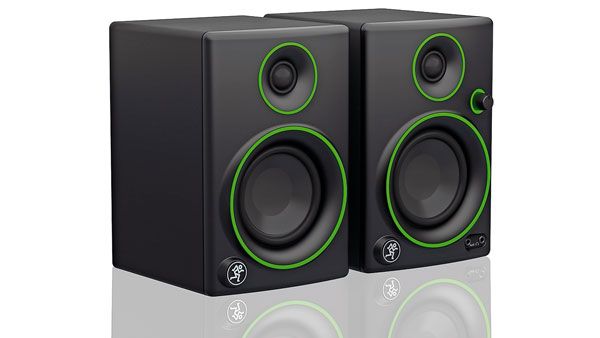
Mackie CR3
These 50W powered monitors deliver a large sound through their 3-inch polypropylene-coated woofers and .75-inch ferrofluid-cooled silk-dome tweeters, with a frequency crossover of 3kHz.
They have the 'one active, one passive' arrangement tbat's standard for monitors of this size and price, with the added bonus of being able to switch the powered side to either the left or right.
The sound is detailed, but the top-end can get a bit swallowed up by the bass extension courtesy of the rear-facing ports. There are no attenuation controls to cope with EQing and room placement but, at this price, it's a small grumble.
4.5 out of 5
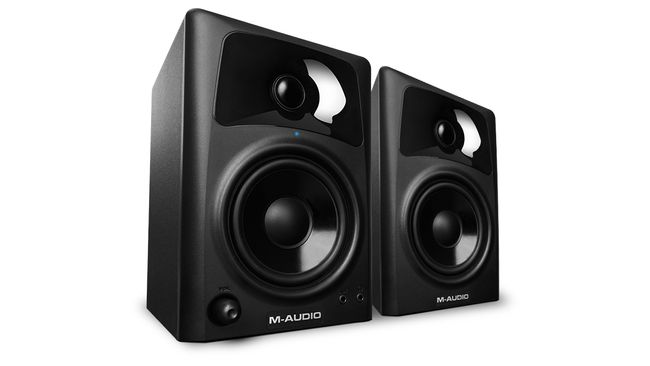
M-Audio AV42
The AV42 from M-Audio is an updated monitor that succeeds the popular AV40. In terms of specs and looks, it's very similar.
The AV42s still feature a 4-inch driver, 1-inch tweeter and 20 Watts of output. However, the grilles have been ditched for a cleaner design, with the main difference being the new 'OptImage IV tweeter wave guide'.
Running them alongside the Mackie CR3s, the AV42s have a slightly more detailed low-end courtesy of the larger driver. They are not as powerful as the Mackies on paper, but you won't notice the difference unless you are cranking up the volume to uncomfortable levels.
We wouldn't suggest these monitors for critical mixing responsibilities, but the AV42s perform admirably in the small-factor stakes, proving once again that the 'multimedia' label shouldn't always put you off.
4 out of 5
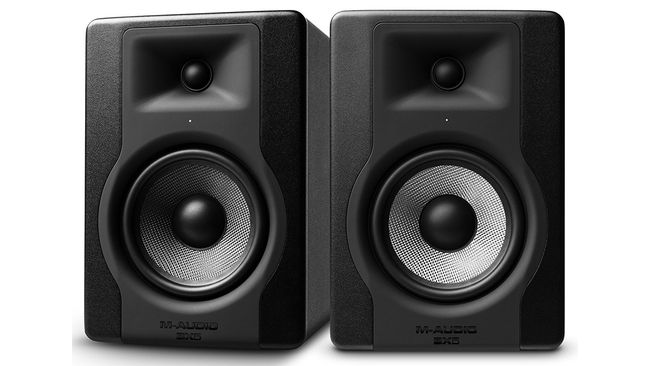
M-Audio BX5 D3
The BX5 has established itself as a reliable and affordable compact two-way monitor, maintaining its popularity through a number of updated and restyled versions.
Its latest incarnation carries through many common features from recent editions, including a one-inch silk-domed tweeter, five-inch woven Kevlar woofer (both magnetically-shielded) and vinyl laminated MDF cabinet.
Once again it uses a rear ported design to improve bass extension, and further rear panel elements include Volume control, XLR and TRS jack inputs and three Acoustic Space bass settings (Flat, -2dB and -4dB) to help compensate for the monitor position in the room. Much like the recent BX5 Carbon, you can connect both XLR and jack inputs simultaneously.
Overall, the BX5 D3 is a solid, compact performer with some useful features. And with its reliable sound, it's one of the best compact affordable monitors out there.
4.5 out of 5
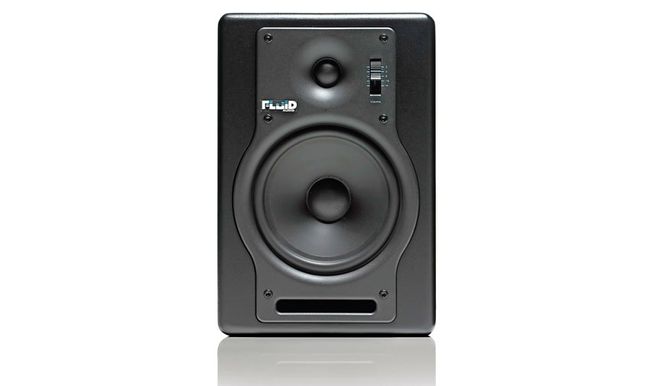
Fluid Audio F5
These compact powered monitors feel light but solid. The rear panel sports a finned amplifier with power inlet/switch below and line inputs above (XLR, TRS and RCA). The rigid plastic front baffle centre houses the silk dome tweeter (in waveguide), coated paper composite woofer, volume trim fader and slot-shaped bass reflex port.
Without a doubt, the F5s deliver performance beyond their price point. Good transient response, a smooth mid to HF range and some punchy power make them good candidates if you have a small budget.
The slightly bulbous low-end isn't marred by any overt resonant peaks, but is something you'll have to get used to. Ultimately, though, the F5s give you a lot of speaker for your money.
4 out of 5
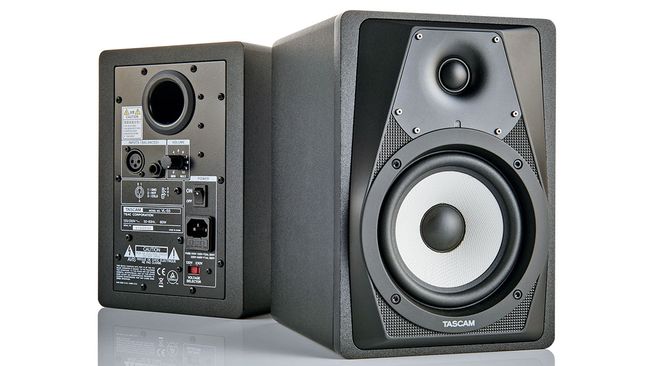
Tascam VL-S5
At 10 inches high, the VL-S5 is a compact monitor, and with a footprint of around 7 x 8 inches, is eminently suitable for placement, with tweeters at ear level, either side of your computer in a close-working environment.
There's 30 Watts of power driving the 1-inch silk dome tweeter and 40 Watts for the low-end's 5.25-inch Kevlar cone woofer. The crossover frequency between the two has been set at 3.2kHz - a little higher than some rival manufacturers' - to avoid phase distortion in the critical midrange area.
The only control, besides the on/off switch, is a volume knob that has no notches, and connectivity is via a balanced XLR or TRS jack.
Tascam has come up with something that's really rather good with the VL-S5. A pair of these would be a very good practical choice if you do not have a lot of space to place monitors in but still want good quality sound.
A smaller version, the VL-S3, also represents excellent value for money.
4 out of 5
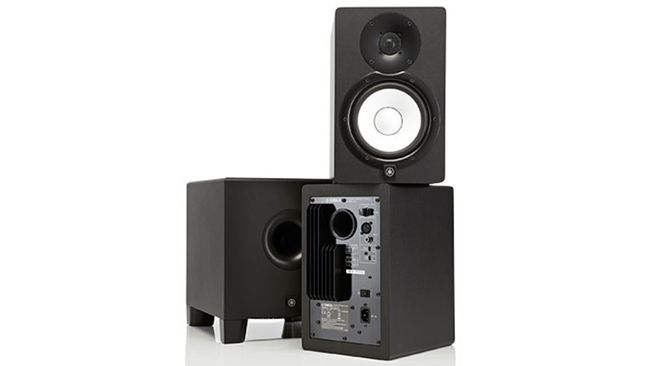
Yamaha HS series
The HS5 and HS8 appear to be direct replacements for the HS50M and HS80M - the 5s and 8s referring to the size of their LF drivers in inches. The HS7 is positioned between the two, being equipped with a 6.5-inch LF driver (we guess H7 sounds sexier than H6.5).
Now, to many of us, the HS series look is very familiar, that white LF driver being highly reminiscent of the passive NS-10 family, discontinued some time ago and ubiquitous in professional studios since it was first launched back in the 1980s.
That look is no coincidence; the original NS-10 designer was involved here, and Yamaha is keen to promote the idea of a family lineage, saying that the HS series shares the same design philosophy. They seem to have got it spot on.
Reproducing a wide variety of music and various individual instruments, the HS monitors offer plenty of clarity, nice depth of field and a good sense of stereo positioning. The frequency response seems well-balanced, with nothing missing and nothing overtly hyped and, for a small nearfield, the bottom end is defined in a way that should give you a decent reading of the foundations of your track.
If you want more emphasis on the bottom end, or are looking to put together a 5.1 surround system, you can add the HS8S subwoofer to the setup, which brings a further 150 watts of low-end power.
4.5 out of 5
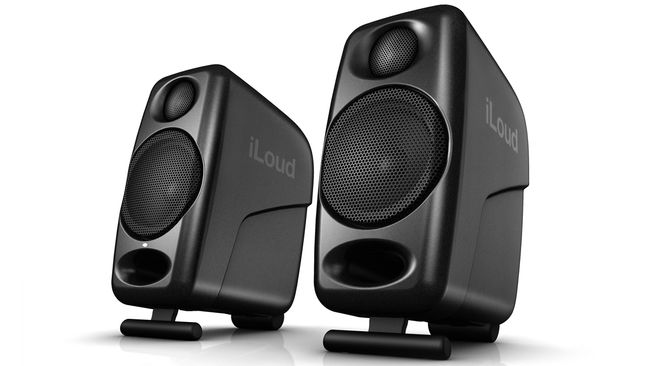
IK Multimedia iLoud Micro Monitor
IK Multimedia thinks it has a solution for those who want to take a compact yet high-quality set of monitors on the road, and it's called the iLoud Micro Monitor.
Appearance-wise, the speakers have an appealing 'roundness' to them, and are reassuringly weighty, though they're certainly small and light enough to be carried around. There's a cable connection between the two of them, with the left-hand speaker housing all the controls and connectivity options.
There are both TRS 1/8-inch and RCA inputs, while controls comprise a rear-mounted volume knob, EQ switches and a Bluetooth pairing button.
Each speaker housing contains a 3/4-inch tweeter, 3-inch woofer and bass reflex port, and we're promised 50W RMS with bass response down to 55Hz. The Micros are certainly loud enough for small project studio use - almost surprisingly loud, given their diminutive size - and, based on our tests, do a decent job of delivering the uncoloured, flat frequency response that they promise, with plenty of detail across the range and only a slight hint of boominess in the bottom end.
It may turn out to be the case that the iLoud Micro Monitor is most commonly bought as a second set of monitors; a setup that can be moved around easily and also one that can provide a different perspective on a mix. That said, if your main studio setup comprises little more than the corner of your living room, they're certainly worth considering as a main monitor, too.
4.5 out of 5
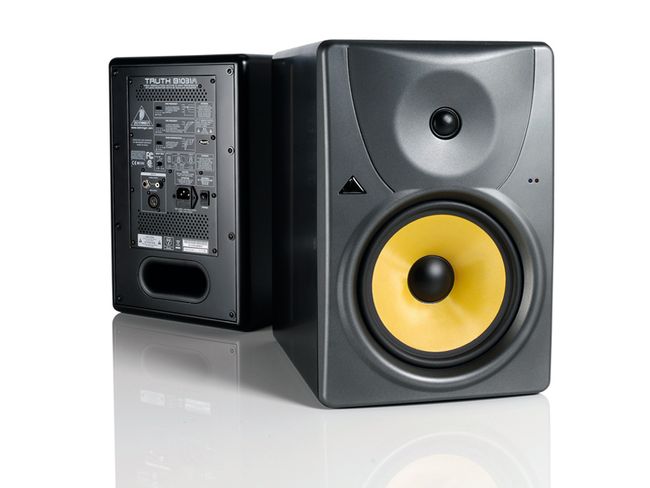
Behringer Truth B1031A
Behringer is a company that’s built its reputation on producing usable products at bargain prices, and the B1031As are a perfect example of this philosophy. They don’t look or sound cheap, but the price is very attractive indeed.
The all-important bass sounds tight and doesn’t distort, while the top end of the mix is nicely detailed without being too sharp. There monitors provide plenty of detail in the midrange, too - it’s not difficult to pick out the different instruments in your mix.
The B1031As have a nice wide sweet spot, meaning that you don’t need to worry about positioning yourself too precisely in front of them. They’re comfortable to listen to for long periods, too - these are speakers that you’ll be happy to live with and come at a great price.
4 out of 5
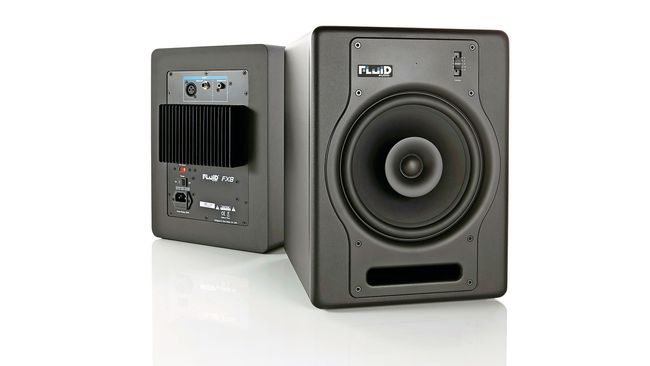
Fluid Audio FX8
The FX8 is the largest studio monitor in the Fluid Audio range and a departure from its usual two-way design that features a tweeter above the bass driver. Here, we're looking at a bi-amped dual concentric (also known as coaxial) design.
There are no tonal controls at all to adjust - just a volume control, and that is placed on the fascia for easy access and runs from silence up to 0dB, with an indented position at -6dB. Connectivity covers all the common options, with XLR, 1/4-inch jack and RCA phono sockets.
In use, there's a very good sense of sound location across the stereo spread, as well as a decent sense of space back to front. Clarity of sound is also very good across the frequency range, and the 8-inch woofers, combined with the bass reflex port, will give you plenty of bottom-end.
As with any monitor, it's a matter of getting familiar with the sound but, overall, we feel that the FX8s are monitors that we would have no trouble using on critical mixes.
4 out of 5
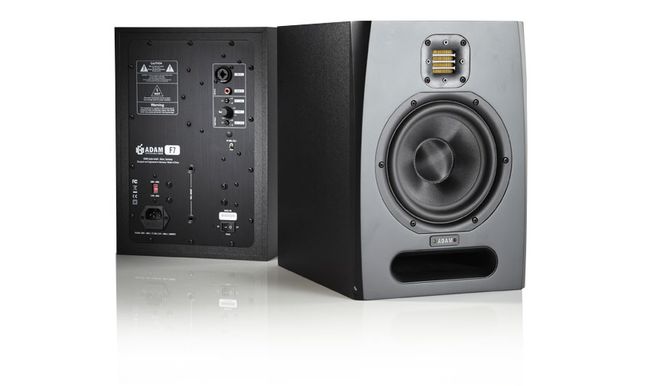
Adam F5/F7
The F5 and F7 use 5- and 7-inch woofers respectively. These are a new design combining glass fibre and a paper backing. The tweeters, meanwhile, use Adam's X-ART design.
Both models include the same rear panel controls, which are two +/- 6dB shelving EQs at 300Hz and 5kHz and a volume control (-inf to +6dB). There's also an 80Hz high-pass filter designed primarily for using with the optional F-Sub. Inputs are via either a phono or combination jack/XLR.
Fire up these monitors and they immediately sound just as you would expect: open in the top end with plenty of upper-mid detail; solid in the low mid and mid range and reasonably well balanced at the bottom.
The F7 sounds more expansive and engrossing, while the F5 is a bit more precise, particularly in the mid range. At the bottom, the F7 extension is much better.
On balance we prefer the F7s, mostly because the scale of the delivery is bigger and they sound more capable at high levels. That said, the F5 would be great for smaller rooms.
4.5 out of 5
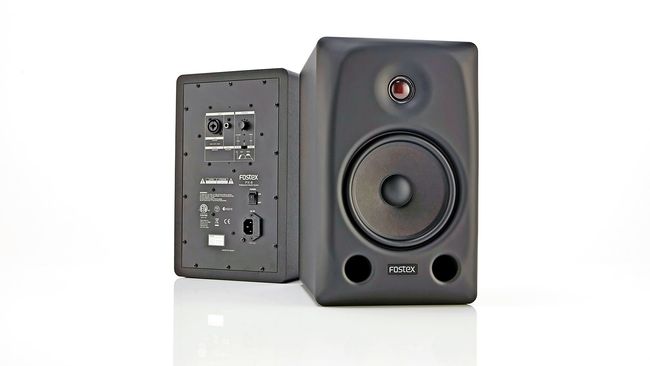
Fostex PX-6
The PX-6 is a powered two-way nearfield monitor that is equipped with totally new 6.5-inch LF and 1-inch HF drivers and features extensive onboard DSP.
With 50 watts driving the low-end and 28 watts driving the top, the PX-6s should be plenty loud enough for a small/medium sized room. The DSP certainly seems to be doing its stuff when it comes to imaging, as everything seems pinpoint accurate and precise across the stereo field.
Sonically, there are no nasty surprises. The overall spread of frequencies seems naturally balanced, with nothing unduly emphasised or lacking, and the top-end adjustment is tastefully engineered to brighten things or subdue them slightly to suit your preferences.
4 out of 5
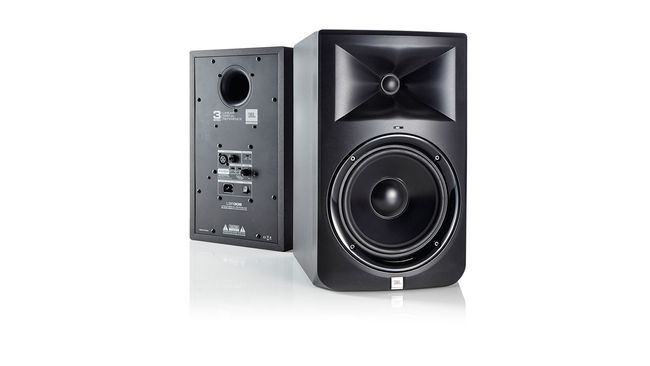
JBL Series 3 LSR308
Not only does the LSR308 feature two 56 Watt class D amps, but it also contains an ample 8-inch low-frequency driver. Throw in JBL's patented Slip Stream low-frequency port and you end up with some serious low-end action.
Build quality is good for a monitor in this price bracket, and it's pretty light when you consider its size. You have the choice of XLR and 1/4-inch jack inputs, both of which are balanced. There are also handy low- and high-frequency trim controls, which allow adjustments to be made in problem spaces.
All in all, the LSR308s represent excellent value for money and deliver a sound that is truly larger than life. They would be ideal for someone who's looking for something with a good deal of low-end extension and the ability to go a little louder than other monitors.
4 out of 5
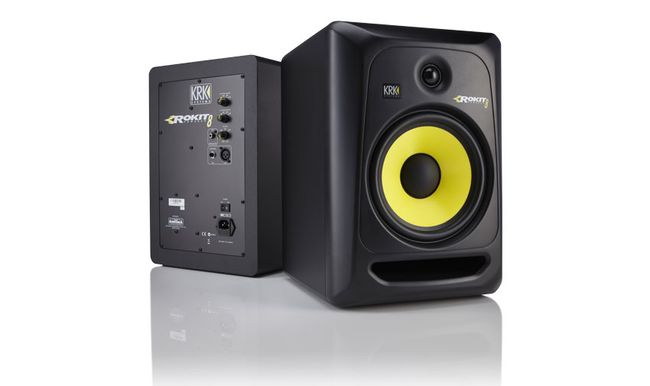
KRK Rokit 8 G3
Designed and engineered in the USA but made in China, the Rokit 8 (RP8), the largest of the three two-way models in KRK's Rokit series is now in its newly-released third generation. This brings (among other things) an upgraded amplifier and tweeter and the inclusion of low frequency adjustment.
The RP8 offers XLR, 1/4-inch jack and RCA phono inputs. Another thoughtful touch is that the cabinets come fitted with a foam pad on their base to decouple them from whatever surface they are standing on.
This is a punchy monitor with a smooth top end, but most apparent is the solid and powerful bass performance. Once you've familiarised yourself with their sound, these are very capable speakers.
4 out of 5
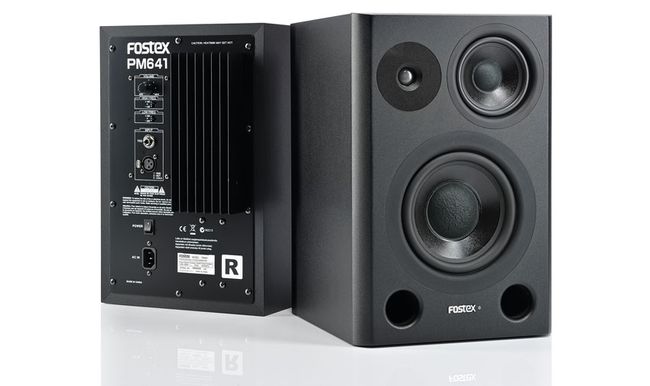
Fostex PM641
The PM641 is a three-way monitor and has the mid-range driver and tweeter sitting next to each other on a horizontal axis above the woofer. This serves to minimise the physical height of the enclosure box.
The rear of each cabinet is dominated by a large finned heat-sink adjacent to the connection sockets, which are an XLR and a 1/4-inch TRS jack. There’s also a pair of three-way switches to change the response.
Performance-wise, the bass end is impressive and kick drums come fat and rounded. We'd describe the mids and top-end as ‘smooth’ - there's no hype or harshness here - and it feels like you could use these on long sessions without fatigue.
The PM641s might cost more than some of the budget options, but just shy of £400 is not a bad price to pay for a nicely practical three-way monitoring system.
4 out of 5
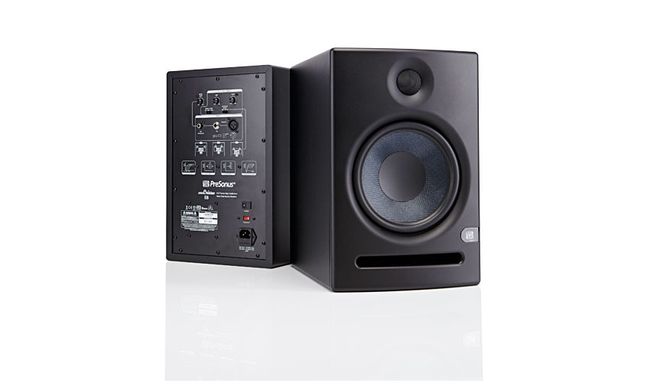
PreSonus Eris E8
The E8 is quite a large nearfield monitor and is bi-amped. The 8-inch Kevlar low-frequency transducer is driven by a 75-watt class AB amp, while the 1.25-inch silk-dome high-frequency tweeter gets 65W of class AB amplification. Besides the woofer and tweeter there's a horizontal front port.
All connections and controls reside on the rear panel. You should have no trouble getting a signal into the E8 as there are XLR, balanced TRS jack and unbalanced RCA (phono) sockets. Besides the necessary input gain knob, the E8 has a range of controls for tweaking the sound.
In use, the clarity of these monitors is good, and the overall balance of frequencies is one that you can work with. The top end comes through prominently and clearly (revealing the detail), while the bottom end is tight and focussed.
We'd be happy to use the E8s to mix our tracks; they can sound pretty big considering their compact cabinet. This is a monitor that should fit tidily into most rooms and will let you hear the detail in your mixes.
4 out of 5
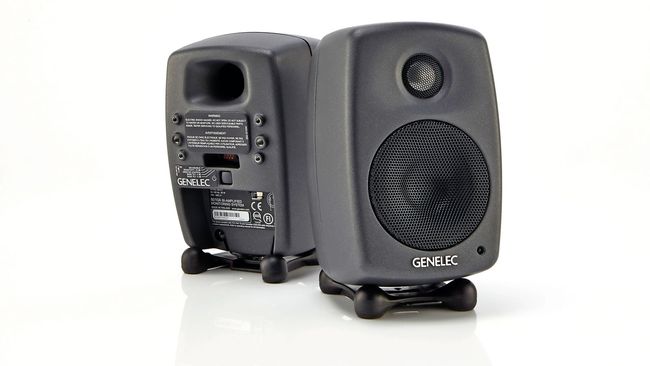
Genelec 8010A
The 8010A is the smallest of Genelec's 8000 bi-amplified monitors, but you might be taken aback by how large these little speakers sound.
The low-frequency response is particularly impressive, while at the top end the 8010As possess a smooth characteristic that's accurate and free from hyping. With a monitor of this size we would expect a harshness in the highs and upper-mids, but that is not in evidence here at all, and the mid frequencies are well balanced and accurate.
There is enough scope for response adjustment to suit any number of mounting situations, from desktops to stands, and there's plenty of power, too. If you want a high-quality monitor that's both portable and durable, you might just have found it.
4.5 out of 5
NEXT: 17-End
0