


- Beranda
- Berita Luar Negeri
Gagah berani,Taiwan stands up to China with World War II military parade
...

TS
hahaiyaa09
Gagah berani,Taiwan stands up to China with World War II military parade

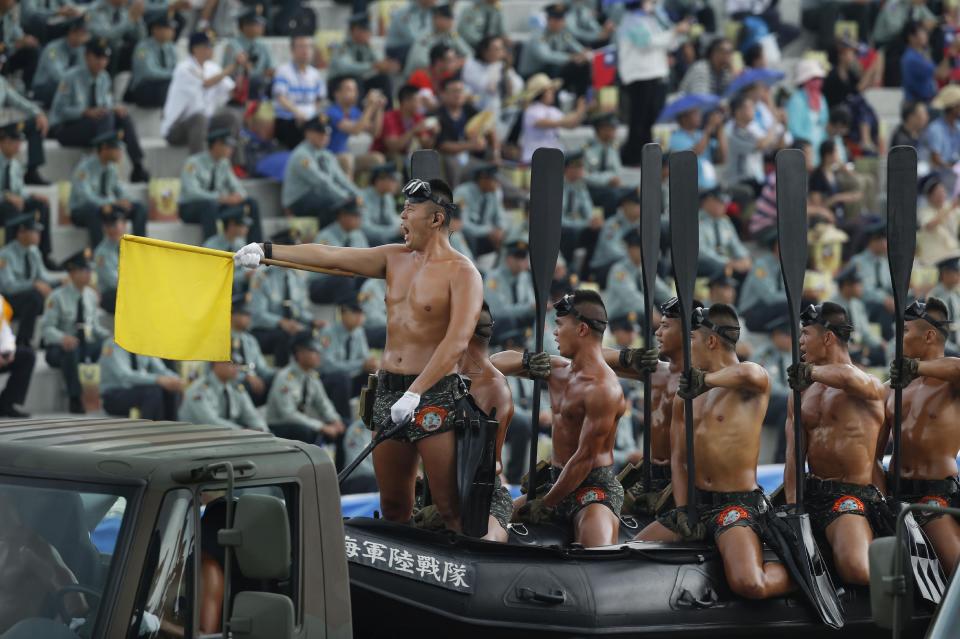
Taiwan marched out thousands of troops and displayed its most modern military hardware Saturday to spotlight an old but often forgotten claim that its forces, not the Chinese Communists, led the campaign that routed imperial Japan from China 70 years ago.
The military staged an unusually large two-hour parade of homegrown missiles, Apache attack helicopters and a mountain bike team designed for stealth missions, followed by awards for aged World War II veterans in their attire from the 1940s.
China and Taiwan split during civil war in 1949 and today's China — more militarily and economically powerful than Taiwan — claims that the Chinese Communists had directed the resistance against the Japanese. Mainland officials have argued that the Communists' advice and fighting skills were crucial to the victory.
Taiwan's Nationalist Party ruled all of China when Japan invaded parts of the country from 1931, forming a central stage of the Asian World War II theater. In one attack, the Japanese massacred between 40,000 and 300,000 Chinese in what has become known as the Nanjing Massacre.
Officials in Taiwan say that the Communist forces had a minor role in fighting the Japanese alongside the Republic of China troops, and that during China's eight-year resistance against Japan they were mainly building up their own ranks and fighting a civil war they would eventually win.
"The war of resistance was led by the Republic of China and Chairman Chiang Kai-shek was the force behind it," Taiwan President Ma Ying-jeou said in a speech after the parade, referring to the old Nationalist government's strongman. "No one is allowed to distort that."
After losing the civil war, the Nationalists rebased in Taiwan in the late 1940s, and their constitutional Republic of China government has governed the western Pacific island since then.[/b]
China's Communists also claim sovereignty over Taiwan and insist that the two sides eventually reunify, though opinion polls on the island show most Taiwanese prefer self-rule.
Taiwan's effort to cast the war in its favor comes as it seeks to avoid being eclipsed internationally by China, which has eight times more diplomatic allies.
"It's because the rest of the world is ignoring the Republic of China, so they want their contribution to be well recognized," said Kweibo Huang, associate professor of diplomacy at National Chengchi University in Taipei. "At least there's a domestic outcome, which is that everyone in Taiwan shares awareness as a nation or a sovereign state."
China will offer a three-day public holiday in September to mark the war anniversary, and the official Xinhua news agency says the government will hold its first World War II memorial parade that month.
Beijing had invited Taiwan representatives, but the island government said in April that officials would be banned by law and that any private citizens should attend with caution.
haiyaaa ciilaaka luuwa weelas waaa
yaaa jelas laaa Koumintang yg perang melawan Japano-san bukan nyeee Kun Chang Tang Penghianat yg BUNUH jutaan Sickmen of Asia dan Merusak Kebudayaan Tiongkok dan menjual Tiongkok ke Russia waaa!!!
The TRUTH must be Told waaa

0
4.8K
26

Komentar yang asik ya
Mari bergabung, dapatkan informasi dan teman baru!

Berita Luar Negeri
82KThread•20.1KAnggota
Tampilkan semua post

hahaiyaa.20
#23
Quote:
haiyaaa ciilaaka wuuthuutt waaa
Dilema waaa....,lebih baik hidup bercermin bangkai atawa mati berkalang tanah!!???
Mana yg lebih terhormat mati melawan Bully boy atawa hidup jd babu Bully boy!!???
Mungkin duniyeee musti malu ame negara kecil macam Palau yg berani nentang Intimidasi Sickmen of Asia waaa!!!

Tiny tourism-reliant Pacific nation defies pressure from its biggest source of visitors

Tommy Remengesau, Palau's president, and Tsai Ing-wen, leader of the Democratic Progressive party, which has replaced the more China-friendly Nationalist party in power in Taiwan
One of just 20 nations keeping formal diplomatic ties with Taiwan, Palau was named in a notice issued by Chinese officials last month warning travel agencies that it was illegal to advertise group tours to destinations not on China’s approved list.
But while a clampdown on Chinese visitors would hurt the Palau economy, the nation said it had no plans to switch its allegiance away from Taipei.
“Palau is a country of laws, it is a democracy and we make our own decisions,” said Olkeriil Kazuo, spokesperson for Palau’s president, Tommy Remengesau.
China is the biggest source of visitors to tourist-dependent Palau, comprising roughly half the 113,000 visitors to the archipelago so far this year, according to the Asian Development Bank.
Tensions between China and Taiwan, a self-governed island that Beijing regards as a renegade province, were heightened last year when the Democratic Progressive party led by Tsai Ing-wen won power, replacing the more China-friendly Nationalist party, or Kuomintang.
The republication of China’s list of approved travel destinations reflects Beijing’s toughening approach towards Taiwan’s allies, experts said.
Mr Kazuo said Beijing’s exclusion of Palau from its list of approved destinations — a measure in place for several years but to date not strictly enforced — has “never affected” the country.

Tourism growth “largely determines economic performance” — the sector accounted for more than half of Palau’s gross domestic product in 2015 — and a “significant” decline in visitors from China, Japan and Taiwan this year has already caused “uncertainty over near-term economic prospects”, according to the ADB.
Dilmei Louisa Olkeriil, Palau’s ambassador to Taiwan, said that, if the number of Chinese visitors suddenly fell, “of course the [tourism] industry will hurt”.
“If China says, ‘no tourists go to Palau’, then no tourists will come to Palau, we need to be aware of that,” she said, adding that Palau must further diversify its source markets to “protect us from something like this”.
In the decades since China was admitted to the UN in 1971, most countries withdrew recognition of the Republic of China, as Taiwan is formally known, to establish relations with Beijing. In a dogged battle for recognition, both sides have long used promises of financial aid and infrastructure spending to attract allies.

But policymakers in Beijing have now decided that China’s political objectives are not “something they can obtain purely by soft power alone”, said Lauren Dickey, a researcher in cross-Strait relations and a visiting fellow at National Chengchi University in Taipei.
“Even when China has relied on the carrot, the threat of the stick has always been there. The difference is the stick is actually being used this time,” Ms Dickey said.
William Stanton, former head of the American Institute in Taiwan, the unofficial US embassy in Taipei, said it was clear China was “stepping up pressure” against Taiwan.
“It seems to be an important shift,” he said, noting that President Xi Jinping of China had signalled a toughening foreign policy at the Communist party congress in October. “They are a bully and they are going to get worse unless people stand up to them,” said Mr Stanton, who now lectures at National Taiwan University.

0