


- Beranda
- Militer
[Flashback] Mengapa Memilih Sukhoi - "Air Power" sebagai "Deterrent Power" yang Andal
...


TS
pm.vanuatu
[Flashback] Mengapa Memilih Sukhoi - "Air Power" sebagai "Deterrent Power" yang Andal

0
14.4K
65
Thread Digembok
Mari bergabung, dapatkan informasi dan teman baru!

Militer
20.4KThread•10.7KAnggota
Tampilkan semua post
nicronemodez
#35
Quote:
Original Posted By leomar►Terlalu banyak trit yang berkaitan dengan pengganti F-5, maka baiknya saya kutip berita lama yang berkaitan. Kiranya cocok untuk di trit ini karena judulnya Flashback.
Artikel saya potong2 untuk ambil seperlunya saja. Sebenarnya tulisan ini adalah salah satu kenapa Australi ngebet untuk ambil JSF.
_____________________________

Indonesia's TNI-AU has had a long standing interest in the Sukhoi fighters and prior to the Asian economic crisis committed to purchase the Su-30KI. This aircraft was to be supplied by KNAAPO and was derived from the single seat Su-27SMK, a Mid Life Upgrade design package for the baseline Su-27S. The Su-30KI is thus an improved single seat Su-27S, with the improved N001E radar and cassegrain antenna, aerial refuelling probe, centreline OLS-27 IRST, ILS-31 HUD, and provisions for the R-77 Adder missile. This variant is more the air superiority fighter than dual role strike fighter and is essentially a low cost upgrade of the basic production KNAAPO Su-27 line - the use of the early configuration centreline IRST installation suggests the Su-30KI may be built from refurbished low time PVO Su-27 airframes.
In late April 2003, Indonesian President Megawati signed an MoU with Russia for the supply of four Sukhoi fighters, two Su-27SK and two Su-30MK (some sources claim Su-35, others Su-30KI) to the Indonesian TNI-AU later this year. Media reports from Jakarta indicated that the TNI-AU intends to acquire between 48 and 54 of these aircraft over this decade, and often report the inclusion of an aerial refuelling capability - part of the Su-30KI configuration. Whether the TNI-AU aircraft are Su-27SKs, Su-35s, Su-30KIs or Su-30MKs is immaterial in the longer term, since the basic KNAAPO/Irkut T-10 family of designs permits incremental retrofits, and cash permitting any of these variants can over time morph into a more advanced model.
Since then the TNI-AU had its four aircraft delivered. In 2006, Indonesian President Susilo Bambang Yudhoyono visited Moscow and ordered an additional six aircraft, as part of a larger arms package.
.....
.....
In close in air combat terms the JSF qualifies as 'double inferior' against the later model Sukhois, since the Sukhois have an advantage in both thrust/weight ratio and in wing loading (interested visitors refer R.L. Shaw's Fighter Combat), and with its canard and thrust vectoring capability will generally be able to gain a firing solution quicker. Because the JSF is designed within the kinematic performance class of the F/A-18 and F-16, it is right in the middle of the performance envelope of aircraft the Sukhoi was designed to kill.
![kaskus-image]()
This chart compares some cardinal design parameters for the Su-30MK series, the JSF and the F/A-18 family, using manufacturer's data. The effective wing loading of the Su-30 is better than depicted, since the aircraft's configuration delivers a considerable amount of body lift. While in the near term the AESAs in the JSF and F/A-18E/F will be competitive, in the longer term the retrofit of AESA technology in the N011M series radar will see the advantage in power aperture go to the Sukhoi - both the JSF and F/A-18E/F are aperture size and cooling capacity limited in growing AESA performance (Author).
![kaskus-image]()
What happens when the existing OLS-27/30/31 series IRST is replaced with a newer longwave Focal Plane Array device - such as a single chip QWIP device? The result will be a capability to engage opposing aircraft under clear sky conditions regardless of RCS reduction measures. While the supercruising F/A-22A can defeat such techniques by kinematics alone, fighters in the teen series performance envelope will have to contend with BVR shots using the R-27ET, R-77, R-77T and R-77M cued by the thermal imaging search and track set. Similar issues arise with the deployment of modern ESM receivers on the Su-30MK, analogous to a number of existing Western systems. The Su-30MK series can then launch long range BVR missiles such as the R-27ET, R-77T with infrared seekers, or the R-27EP and R-77P with passive radio-frequency anti-radiation seekers. If cued by such sensors or offboard sources, these weapons will permit the Su-30MK to engage the JSF despite the JSF's good forward sector radar stealth performance (Author).
On publicly available data the JSF is likely to be detected and engaged by an N011M ESA equipped Su-30 inside the 10 to 20 nautical miles head on range envelope, unless the JSF can get the first shot off and successfully kill the Sukhoi. If the Sukhoi can close with the JSF, all bets are off on the JSF's ability to survive the close in engagement.
For Australia the Su-30 presents the prospect of a more difficult to defend sea-air gap. While we might choose to argue ad nauseam as to whether a future Indonesian regime might opt to get into a fight with Australia, or debate the likelihood of PLA-AF Sukhois being based in the northern apporaches at a future date, or debate India's future role in the near region, the stark reality is that the tyranny of distance which has protected Australia for decades is being rapidly eroded by developing capabilities across the region.
In this context the 2002 JSF decision, and ongoing lobbying for F/A-18E/F interim fighters, seem both to be quite incongruous. Neither aircraft offers a decisive capability margin against the Su-30 series, especially longer term as the sensors, avionics and weapons evolve in the Sukhois and regional players acquire AEW&C aircraft and other supporting capabilities.
The belief in some Canberra circles that the JSF will somehow solve all of the RAAF's force structure problems does not stand up to scrutiny, in the light of the known capabilities and demonstrated growth potential of the Sukhoi Su-30 which is rapidly becoming the 'standard' fighter across the region. Similarly the belief that F/A-18E/F interim fighters will somehow address the capability gap in the F/A-18A HUG fleet is hard to accept. The belief that the F-111's heavyweight counter-air strike capability is now irrelevant also conflicts with the reality that the best way to fight an Su-30 without an F-22A is to shut down its basing from day one of a conflict - and if possible convert the Sukhois to scrap metal in situ - neither achievable with a handful of standoff missile shots.
http://www.ausairpower.net/APA-Flanker.html
__________________________
Artikel saya potong2 untuk ambil seperlunya saja. Sebenarnya tulisan ini adalah salah satu kenapa Australi ngebet untuk ambil JSF.
_____________________________

Indonesia's TNI-AU has had a long standing interest in the Sukhoi fighters and prior to the Asian economic crisis committed to purchase the Su-30KI. This aircraft was to be supplied by KNAAPO and was derived from the single seat Su-27SMK, a Mid Life Upgrade design package for the baseline Su-27S. The Su-30KI is thus an improved single seat Su-27S, with the improved N001E radar and cassegrain antenna, aerial refuelling probe, centreline OLS-27 IRST, ILS-31 HUD, and provisions for the R-77 Adder missile. This variant is more the air superiority fighter than dual role strike fighter and is essentially a low cost upgrade of the basic production KNAAPO Su-27 line - the use of the early configuration centreline IRST installation suggests the Su-30KI may be built from refurbished low time PVO Su-27 airframes.
In late April 2003, Indonesian President Megawati signed an MoU with Russia for the supply of four Sukhoi fighters, two Su-27SK and two Su-30MK (some sources claim Su-35, others Su-30KI) to the Indonesian TNI-AU later this year. Media reports from Jakarta indicated that the TNI-AU intends to acquire between 48 and 54 of these aircraft over this decade, and often report the inclusion of an aerial refuelling capability - part of the Su-30KI configuration. Whether the TNI-AU aircraft are Su-27SKs, Su-35s, Su-30KIs or Su-30MKs is immaterial in the longer term, since the basic KNAAPO/Irkut T-10 family of designs permits incremental retrofits, and cash permitting any of these variants can over time morph into a more advanced model.
Since then the TNI-AU had its four aircraft delivered. In 2006, Indonesian President Susilo Bambang Yudhoyono visited Moscow and ordered an additional six aircraft, as part of a larger arms package.
.....
.....
In close in air combat terms the JSF qualifies as 'double inferior' against the later model Sukhois, since the Sukhois have an advantage in both thrust/weight ratio and in wing loading (interested visitors refer R.L. Shaw's Fighter Combat), and with its canard and thrust vectoring capability will generally be able to gain a firing solution quicker. Because the JSF is designed within the kinematic performance class of the F/A-18 and F-16, it is right in the middle of the performance envelope of aircraft the Sukhoi was designed to kill.
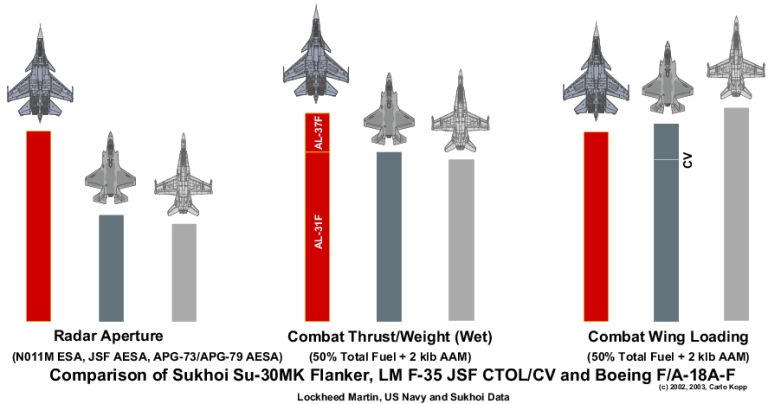
This chart compares some cardinal design parameters for the Su-30MK series, the JSF and the F/A-18 family, using manufacturer's data. The effective wing loading of the Su-30 is better than depicted, since the aircraft's configuration delivers a considerable amount of body lift. While in the near term the AESAs in the JSF and F/A-18E/F will be competitive, in the longer term the retrofit of AESA technology in the N011M series radar will see the advantage in power aperture go to the Sukhoi - both the JSF and F/A-18E/F are aperture size and cooling capacity limited in growing AESA performance (Author).
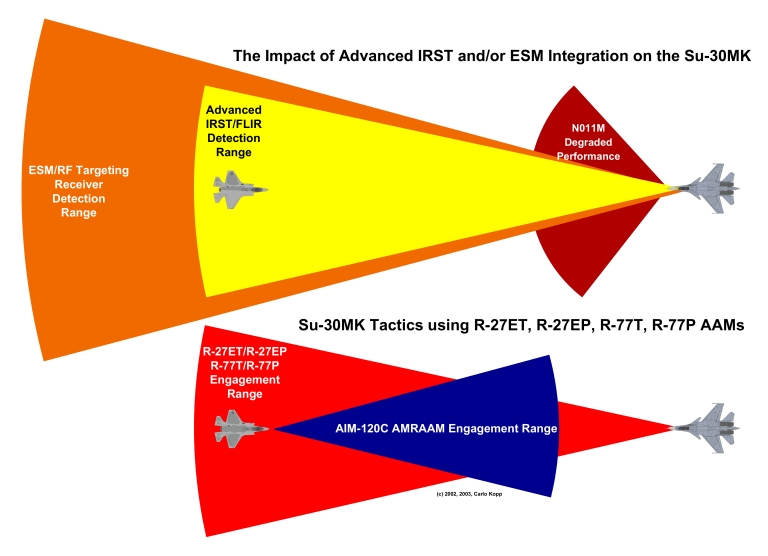
What happens when the existing OLS-27/30/31 series IRST is replaced with a newer longwave Focal Plane Array device - such as a single chip QWIP device? The result will be a capability to engage opposing aircraft under clear sky conditions regardless of RCS reduction measures. While the supercruising F/A-22A can defeat such techniques by kinematics alone, fighters in the teen series performance envelope will have to contend with BVR shots using the R-27ET, R-77, R-77T and R-77M cued by the thermal imaging search and track set. Similar issues arise with the deployment of modern ESM receivers on the Su-30MK, analogous to a number of existing Western systems. The Su-30MK series can then launch long range BVR missiles such as the R-27ET, R-77T with infrared seekers, or the R-27EP and R-77P with passive radio-frequency anti-radiation seekers. If cued by such sensors or offboard sources, these weapons will permit the Su-30MK to engage the JSF despite the JSF's good forward sector radar stealth performance (Author).
On publicly available data the JSF is likely to be detected and engaged by an N011M ESA equipped Su-30 inside the 10 to 20 nautical miles head on range envelope, unless the JSF can get the first shot off and successfully kill the Sukhoi. If the Sukhoi can close with the JSF, all bets are off on the JSF's ability to survive the close in engagement.
For Australia the Su-30 presents the prospect of a more difficult to defend sea-air gap. While we might choose to argue ad nauseam as to whether a future Indonesian regime might opt to get into a fight with Australia, or debate the likelihood of PLA-AF Sukhois being based in the northern apporaches at a future date, or debate India's future role in the near region, the stark reality is that the tyranny of distance which has protected Australia for decades is being rapidly eroded by developing capabilities across the region.
In this context the 2002 JSF decision, and ongoing lobbying for F/A-18E/F interim fighters, seem both to be quite incongruous. Neither aircraft offers a decisive capability margin against the Su-30 series, especially longer term as the sensors, avionics and weapons evolve in the Sukhois and regional players acquire AEW&C aircraft and other supporting capabilities.
The belief in some Canberra circles that the JSF will somehow solve all of the RAAF's force structure problems does not stand up to scrutiny, in the light of the known capabilities and demonstrated growth potential of the Sukhoi Su-30 which is rapidly becoming the 'standard' fighter across the region. Similarly the belief that F/A-18E/F interim fighters will somehow address the capability gap in the F/A-18A HUG fleet is hard to accept. The belief that the F-111's heavyweight counter-air strike capability is now irrelevant also conflicts with the reality that the best way to fight an Su-30 without an F-22A is to shut down its basing from day one of a conflict - and if possible convert the Sukhois to scrap metal in situ - neither achievable with a handful of standoff missile shots.
http://www.ausairpower.net/APA-Flanker.html
__________________________
Sukhoi was designed to kill.

Ausi sepertinya koq..nganggep negara kita berpotensi besar ya konflik ama kita (menurut wacana diatas)...apa gara" Ausi nyadar mereka sering bikin kesel kita...
0