




TS
816->8055
~ Tempat² Wisata di [Singapore] ~
Hi Guys, Mau bertanya soal info tourism? Mau tau info apa aja seputar Singapore? bisa juga lewat mailing list ikutin petunjuk link dibawah
http://www.kaskus.co.id/showthread.php?t=11866319
atau bisa langsung apply lewat link dibawah ini:
https://groups.google.com/group/regionalsingapore
![~ ۩ ۞ Tempat² Wisata di [Singapore] ۞ ۩ ~](https://dl.kaskus.id/upload.wikimedia.org/wikipedia/commons/thumb/2/2b/Gateway_Avenue_2%2C_Sentosa%2C_Aug_06.JPG/800px-Gateway_Avenue_2%2C_Sentosa%2C_Aug_06.JPG)
Sentosa, which translates to peace and tranquility in Malay, is a popular island resort in Singapore, visited by some five million people a year.[1] Attractions include a two-kilometre long sheltered beach, Fort Siloso, two golf courses and two five-star hotels, and the upcoming Resort Worlds at Sentosa, featuring the new theme park Universal Studios Singapore.
=========================================================
Etymology
=========================================================
Sentosa was once known as Pulau Blakang Mati,[3] which in Malay means the "Island (pulau) of Death (mati) from Behind (blakang)".
The name Blakang Mati is rather old but may not have been founded in the nineteenth century as generally believed. In fact, there exists an island that was identified as Blacan Mati in Manuel Gomes de Erédia's 1604 map of Singapore. Other early references to the island of Blakang Mati include Burne Beard Island in Wilde's 1780 MS map, Pulau Niry, Nirifa from 1690 to 1700, and the nineteenth century reference as Pulau Panjang (J.H. Moor). However, early maps did not separate Blakang Mati from the adjacent island of Pulau Brani, so it is uncertain to which island the sixteenth century place names referred.
The island has gone through several name changes. Up to 1830, it was called Pulau Panjang ("long island"). In an 1828 sketch of Singapore Island, the island is referred to as Po. Panjang. According to Bennett (1834), the name Blakang Mati was only given to the hill on the island by the Malay villagers on the island. The Malay name for this island is literally translated as "dead back" or "behind the dead"; blakang means "at the back" or "behind"; mati means "dead". It is also called the dead island or the island of the dead.
Different versions of how the island came to acquire such an unpropitious name abound. One account attributed the ominous name to murder and piracy in the island's past. A second claimed that the island is the material paradise of warrior spirits buried at Pulau Brani.
A fourth interpretation is that "dead back island" was so-called because of the lack of fertile soil on the hills.
In 1827, Captain Edward Lake of the Bengal Engineers in his report on public works and fortifications had proposed an alternative name for Blakang Mati as the "Island of St George". However, the island was seen as too unhealthy for habitation and his proposed name was never realised.
In a 1972 contest organised by the Singapore Tourist Promotion Board, the island was renamed Sentosa, a Malay word meaning "peace and tranquillity".
=========================================================
History
=========================================================
Pre-1945
![~ ۩ ۞ Tempat² Wisata di [Singapore] ۞ ۩ ~](https://dl.kaskus.id/upload.wikimedia.org/wikipedia/en/c/cc/Fort_siloso_gunners.jpg)
Gunners at work on a 6 Inch Gun emplacement at Fort Siloso.
In the nineteenth century, the island was considered important because it protected the passage into Keppel Harbour. Plans to fortify the island as part of the defence plan for Singapore were drawn up as early as 1827, but few fortifications actually materialised until the 1880s, when the rapid growth of the harbour led to concern over the protection of coal stocks against enemy attack. The forts built on the island were Fort Siloso, Fort Serapong, Fort Connaught and the Mount Imbiah Battery.
The western end of Pulau Blakang Mati, the place where Fort Siloso is now, used to be called sarang rimau (the tiger's den). Salusuh is a kind of herb used as a remedy in childbirth, but there is no explanation of how the fort came to be so-called, the orang laut of Kampong Kopit only knowing the place by the name of sarang rimau. By the 1930s, the island was heavily fortified and a crucial component of Fortress Singapore, and the base of the Royal Artillery.
During the Second World War, the island was a British military fortress. The British set up artillery guns in Fort Siloso that were then pointed to the south, facing the sea in expectation of a seaward Japanese assault. However, the Japanese eventually invaded and captured Singapore from the north, after having done the same to Malaya (now known as West or Peninsular Malaysia). Following the surrender of the Allied Forces on February 15, 1942, the island became a prisoner of war camp, housing Australian and British prisoners of the Japanese.
During the Japanese Occupation, under the Sook Ching Operation, Chinese men who were suspected, often arbitrarily, of being involved in anti-Japanese activities were brutally killed. The beach at Pulau Blakang Mati was one of the killing fields.
1945-1972
After the Japanese surrender in 1945 and the return of Singapore to British rule, the island became the base of the locally enlisted First Singapore Regiment of the Royal Artillery (1st SRRA) in 1947. Other locally enlisted men from Singapore were sent to the island for basic military training before being sent to other units of the British Army in Singapore.
Ten years later, the 1st SRRA was disbanded and its guns dismantled. The coast artillery was replaced with Gurkha infantry units, first the 2/7th Duke of Edinburgh's own Gurkha Rifles and later the 2/10th Princess Mary's own Gurkha Rifles. Fort Siloso and Fort Serapong became a Catholic retreat and a Protestant church house respectively. Fort Connaught was left in ruins.
In the early 1960s, during the Indonesian Confrontation, the 2/10th unit defended the island against Indonesian saboteurs. With the end of the Confrontation in 1966 and the withdrawal of the Gurkha units from the island, the British handed over Sentosa to the Singapore Armed Forces of the newly independent Government of Singapore in 1967.
In 1967, Pulau Blakang Mati became the base for the Singapore Naval Volunteer Force, which relocated there from its old base at Telok Ayer Basin. The School of Maritime Training was also set up there, as was the first Naval Medical Centre.
In the 1970s, the government decided to develop the island into a holiday resort for local visitors and tourists.
1972-Present
The island was renamed Sentosa in 1972, which means peace and tranquillity in Malay, from a suggestion by the public.[3] The Sentosa Development Corporation was formed and incorporated on 1 September 1972 to oversee the development of the island.[3] Since then, some S$420 million of private capital and another S$500 million of government funds have been invested to develop the island.[3]
In 1974 the Singapore Cable Car system was built, linking Sentosa to Mount Faber.[5] A series of attractions were subsequently opened for visitors including Fort Siloso, Surrender Chamber wax museum, Musical Fountain, and the Underwater World. The causeway bridge was opened in 1992 connecting Sentosa to the mainland.[5]
The Sentosa Monorail system was opened in 1982 to transport visitors to various stations located around the island.[5] On 16 March 2005, the monorail service was discontinued to make way for the new Sentosa Express, which commenced operations on 15 January 2007.[5] An environmental assessment conducted by the government of Singapore concluded that the construction of the resorts on Sentosa would to result in high likelihood of high scale biodiversity loss, habitat destruction, soil erosion and climate change, as well as several other destructive ecological impacts.[1]
=========================================================
Geography
=========================================================
The island has an area of 5 square kilometres. It lies just half a kilometre (a quarter of a mile) away from the southern coast of the main island of Singapore. It is Singapores fourth largest island (excluding the main island). 70% of the island is covered by secondary rainforest, the habitat of monitor lizards, monkeys, peacocks, parrots as well as other native fauna and flora. The island also has 3.2 kilometre stretch of white sand beach. Significantly large portions of land are currently being added to Sentosa due to land reclamation.
=========================================================
Transport
=========================================================
Sentosa can be reached from the Singapore mainland via a short causeway or Cable Car, which originates on Mount Faber and passes through HarbourFront en route.
The island is also accessible by the SGD$140 million Sentosa Express monorail, which has four stations on Sentosa. Opened in 15 January 2007, the terminus of the line is at the VivoCity shopping mall on the mainland, which is in turn served by the HarbourFront MRT Station of the North East MRT Line. The journey takes four minutes. The WaterFront Station of the monorail is expected to open in 2010.
Within Sentosa there are three bus services, identified as Blue, Yellow and Red lines, and a tram service called the Beach Train. Since 1998, passenger cars have been allowed to enter the island.
http://www.kaskus.co.id/showthread.php?t=11866319
atau bisa langsung apply lewat link dibawah ini:
https://groups.google.com/group/regionalsingapore
Sentosa
Spoiler for pictures:
Sentosa, which translates to peace and tranquility in Malay, is a popular island resort in Singapore, visited by some five million people a year.[1] Attractions include a two-kilometre long sheltered beach, Fort Siloso, two golf courses and two five-star hotels, and the upcoming Resort Worlds at Sentosa, featuring the new theme park Universal Studios Singapore.
=========================================================
Etymology
=========================================================
Sentosa was once known as Pulau Blakang Mati,[3] which in Malay means the "Island (pulau) of Death (mati) from Behind (blakang)".
The name Blakang Mati is rather old but may not have been founded in the nineteenth century as generally believed. In fact, there exists an island that was identified as Blacan Mati in Manuel Gomes de Erédia's 1604 map of Singapore. Other early references to the island of Blakang Mati include Burne Beard Island in Wilde's 1780 MS map, Pulau Niry, Nirifa from 1690 to 1700, and the nineteenth century reference as Pulau Panjang (J.H. Moor). However, early maps did not separate Blakang Mati from the adjacent island of Pulau Brani, so it is uncertain to which island the sixteenth century place names referred.
The island has gone through several name changes. Up to 1830, it was called Pulau Panjang ("long island"). In an 1828 sketch of Singapore Island, the island is referred to as Po. Panjang. According to Bennett (1834), the name Blakang Mati was only given to the hill on the island by the Malay villagers on the island. The Malay name for this island is literally translated as "dead back" or "behind the dead"; blakang means "at the back" or "behind"; mati means "dead". It is also called the dead island or the island of the dead.
Different versions of how the island came to acquire such an unpropitious name abound. One account attributed the ominous name to murder and piracy in the island's past. A second claimed that the island is the material paradise of warrior spirits buried at Pulau Brani.
A fourth interpretation is that "dead back island" was so-called because of the lack of fertile soil on the hills.
In 1827, Captain Edward Lake of the Bengal Engineers in his report on public works and fortifications had proposed an alternative name for Blakang Mati as the "Island of St George". However, the island was seen as too unhealthy for habitation and his proposed name was never realised.
In a 1972 contest organised by the Singapore Tourist Promotion Board, the island was renamed Sentosa, a Malay word meaning "peace and tranquillity".
=========================================================
History
=========================================================
Pre-1945
Spoiler for pic:
Gunners at work on a 6 Inch Gun emplacement at Fort Siloso.
In the nineteenth century, the island was considered important because it protected the passage into Keppel Harbour. Plans to fortify the island as part of the defence plan for Singapore were drawn up as early as 1827, but few fortifications actually materialised until the 1880s, when the rapid growth of the harbour led to concern over the protection of coal stocks against enemy attack. The forts built on the island were Fort Siloso, Fort Serapong, Fort Connaught and the Mount Imbiah Battery.
The western end of Pulau Blakang Mati, the place where Fort Siloso is now, used to be called sarang rimau (the tiger's den). Salusuh is a kind of herb used as a remedy in childbirth, but there is no explanation of how the fort came to be so-called, the orang laut of Kampong Kopit only knowing the place by the name of sarang rimau. By the 1930s, the island was heavily fortified and a crucial component of Fortress Singapore, and the base of the Royal Artillery.
During the Second World War, the island was a British military fortress. The British set up artillery guns in Fort Siloso that were then pointed to the south, facing the sea in expectation of a seaward Japanese assault. However, the Japanese eventually invaded and captured Singapore from the north, after having done the same to Malaya (now known as West or Peninsular Malaysia). Following the surrender of the Allied Forces on February 15, 1942, the island became a prisoner of war camp, housing Australian and British prisoners of the Japanese.
During the Japanese Occupation, under the Sook Ching Operation, Chinese men who were suspected, often arbitrarily, of being involved in anti-Japanese activities were brutally killed. The beach at Pulau Blakang Mati was one of the killing fields.
1945-1972
After the Japanese surrender in 1945 and the return of Singapore to British rule, the island became the base of the locally enlisted First Singapore Regiment of the Royal Artillery (1st SRRA) in 1947. Other locally enlisted men from Singapore were sent to the island for basic military training before being sent to other units of the British Army in Singapore.
Ten years later, the 1st SRRA was disbanded and its guns dismantled. The coast artillery was replaced with Gurkha infantry units, first the 2/7th Duke of Edinburgh's own Gurkha Rifles and later the 2/10th Princess Mary's own Gurkha Rifles. Fort Siloso and Fort Serapong became a Catholic retreat and a Protestant church house respectively. Fort Connaught was left in ruins.
In the early 1960s, during the Indonesian Confrontation, the 2/10th unit defended the island against Indonesian saboteurs. With the end of the Confrontation in 1966 and the withdrawal of the Gurkha units from the island, the British handed over Sentosa to the Singapore Armed Forces of the newly independent Government of Singapore in 1967.
In 1967, Pulau Blakang Mati became the base for the Singapore Naval Volunteer Force, which relocated there from its old base at Telok Ayer Basin. The School of Maritime Training was also set up there, as was the first Naval Medical Centre.
In the 1970s, the government decided to develop the island into a holiday resort for local visitors and tourists.
1972-Present
The island was renamed Sentosa in 1972, which means peace and tranquillity in Malay, from a suggestion by the public.[3] The Sentosa Development Corporation was formed and incorporated on 1 September 1972 to oversee the development of the island.[3] Since then, some S$420 million of private capital and another S$500 million of government funds have been invested to develop the island.[3]
In 1974 the Singapore Cable Car system was built, linking Sentosa to Mount Faber.[5] A series of attractions were subsequently opened for visitors including Fort Siloso, Surrender Chamber wax museum, Musical Fountain, and the Underwater World. The causeway bridge was opened in 1992 connecting Sentosa to the mainland.[5]
The Sentosa Monorail system was opened in 1982 to transport visitors to various stations located around the island.[5] On 16 March 2005, the monorail service was discontinued to make way for the new Sentosa Express, which commenced operations on 15 January 2007.[5] An environmental assessment conducted by the government of Singapore concluded that the construction of the resorts on Sentosa would to result in high likelihood of high scale biodiversity loss, habitat destruction, soil erosion and climate change, as well as several other destructive ecological impacts.[1]
=========================================================
Geography
=========================================================
The island has an area of 5 square kilometres. It lies just half a kilometre (a quarter of a mile) away from the southern coast of the main island of Singapore. It is Singapores fourth largest island (excluding the main island). 70% of the island is covered by secondary rainforest, the habitat of monitor lizards, monkeys, peacocks, parrots as well as other native fauna and flora. The island also has 3.2 kilometre stretch of white sand beach. Significantly large portions of land are currently being added to Sentosa due to land reclamation.
=========================================================
Transport
=========================================================
Sentosa can be reached from the Singapore mainland via a short causeway or Cable Car, which originates on Mount Faber and passes through HarbourFront en route.
The island is also accessible by the SGD$140 million Sentosa Express monorail, which has four stations on Sentosa. Opened in 15 January 2007, the terminus of the line is at the VivoCity shopping mall on the mainland, which is in turn served by the HarbourFront MRT Station of the North East MRT Line. The journey takes four minutes. The WaterFront Station of the monorail is expected to open in 2010.
Within Sentosa there are three bus services, identified as Blue, Yellow and Red lines, and a tram service called the Beach Train. Since 1998, passenger cars have been allowed to enter the island.
Polling
Poll ini sudah ditutup. - 37 suara
Perlukan Thread ini di Sticky ?
Yes, Perlu Sekali [Nice Tread Gan]
89%
No, Biarin aja [Biarin Tenggelam]
11%
0
179.7K
1K

Komentar yang asik ya
Mari bergabung, dapatkan informasi dan teman baru!

Singapore
961Thread•360Anggota
Tampilkan semua post
TS
816->8055
#2
=========================================================
Beaches
=========================================================
![kaskus-image]()
Sentosa has a stretch of sheltered beach of more than two kilometres in length on its southern coast, divided into three portions: Palawan Beach, Siloso Beach, and Tanjong Beach. These beaches are artificial, reclaimed using sand bought from Indonesia and Malaysia.
Palawan Beach
Palawan Beach lies in the centre of the southern coast of Sentosa. There is a suspension bridge that leads to a small islet off the coast which is said to be the Southernmost Point of Continental Asia, or Asia's closest point to the Equator. [10]
There are several bars along the beach offering food and beverage to visitors as well as Beach Station of Sentosa Express.
Siloso Beach
Siloso Beach lies on the west portion of the southern coast and it is known as the place for beach volleyball and other outdoor activities such as canoeing, skim boarding, mountain biking or rollerblading. There are also dining and shopping outlets along the beach. The Shangri-La Rasa Sentosa Resort is located at the western end of Siloso Beach.
Tanjong Beach
Tanjong Beach is a relatively more secluded part of the southern coast. The crescent-shaped beach is sometimes used for special events or parties. The beach bar 'KM8' is located at the beach. KM8 had his last party and closed down on 28.03.2009.
=========================================================
Other facilities
=========================================================
Hotels
There are seven hotels and resorts in Sentosa:
* Shangri-La's Rasa Sentosa is a beachfront five-star hotel located at the western tip of Siloso beach, with 459 rooms and suites.
* The Sentosa Resort & Spa is a five-star hotel with 214 rooms and suites.
* Costa Sands Resort operates a number of chalets and 15 kampung-like huts. It is located on a hill overlooking Siloso Beach.
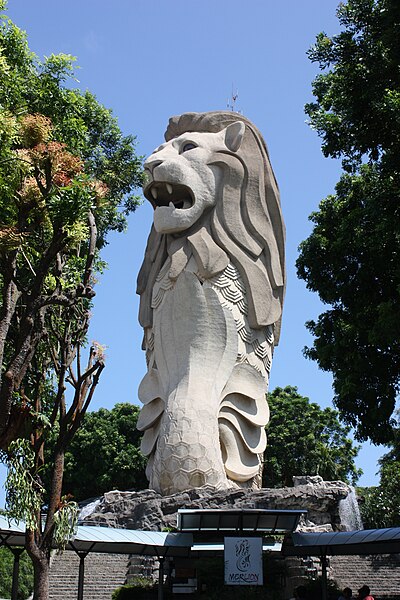
* Treasure Resort (formerly known as Sijori Resort) is a 64 room hotel located behind the Merlion together with the Sijori WonderGolf facility.
* Siloso Beach Resort opened in July 2006. It has 182 rooms to choose from their Superior, Deluxe, Family, and Roof Garden Suite. And 12 Villas. In line with ecologically friendly carbon credit practices, over 600 of the original trees that are native to Sentosa island were preserved. 1000 more fruit trees, flowering plants, exotic ferns, and herbs were planted. With the deliberate architecture of the Resort to circumnavigate and protect these trees.
* Amara Sanctuary Resort Sentosa has five-star hotel facilities, and 121 rooms to offer.
* Capella Singapore is a luxury resort with 112 rooms designed by Lord Norman Foster. It is developed by Pontiac Land. It was officially opened on March 2009.
Upcoming accommodation
* Resorts World at Sentosa(Chinese: 圣淘沙名胜世界 is the name of the integrated resort in development stages on the island of Sentosa, off the southern coast of Singapore. The S$5.2 billion dollar integrated resort is currently being built by Genting International and Star Cruises, who hold a 75% and 25% stake in the project, respectively. The 49 hectare integrated resort will cost S$600 million solely for land, and S$1.6 billion just on a Universal Studios theme park called Universal Studios Singapore. The Theme Park together with 4 hotels and a Casino will be opened in 1Q 2010.
Spa
* Fish Reflexology is a unique foot massage where Turkish spa fish or African spa fish nibble on the dead skin of one's feet, making the skin smooth. This is followed by a Reflexology session. This is available in the Underwater World.
* Health Club and Spa consists of three deluxe suites, one of which has a private whirlpool and steam facility, seven single treatment rooms with attached showers and a Thai Pavilion, which is a private, open air garden unit perched over a fish pond and water fall.
* Spa Botanica is set in the Sentosa Resort & Spa. It has facilities including mud pools and Turkish-styled steam baths.
=========================================================
Events
=========================================================
Barclays Singapore Open
The Barclays Singapore Open golf event is held yearly at the Sentosa Golf Club's Serapong Course. It is the richest golf tournament which is exclusive to the Asian Tour with a US$5 million prize fund.[5]
[edit] Sentosa Balloon Hats Festival
The Sentosa Balloon Hats Festival began in 2004. It is a gathering of local secondary school bands who would do display marches along the beach from Tanjong Beach to Palawan Beach before a mass display event. The participants would wear balloon hats made by themselves and each school comes up with their unique design. At the end of the event, all the students would pop their balloons followed by a release of a large number of balloons into the air. The event began as part of an attempt to create the world record for the gathering of the largest number of balloon hats. But since then, it had developed into a full scale annual event with performances around the whole island before the marching event began.
Beach parties
The Siloso Beach in Sentosa is host to the annual ZoukOut beach dance party organised by Zouk nightclub. On 10 December 2005, some 18,000 people attended the event. [11]
A new year eve party, Siloso NYE Splash is also held annually at the Siloso Beach. On 31 December 2005, the party attracted some 15,000 people.
Sentosa Flowers
Beginning in February 2005, the Sentosa Flowers event is held at the Fountain Gardens, exhibiting a variety of flora and herbs. The festival, which coincides with the Chinese New Year or the "Spring Festival" celebration in Singapore, hosts other activities including a mural painting competition, photograph competitions and a festival market for gardening enthusiasts.
SWATCH-FIVB Beach Volleyball
The SWATCH-FIVB Beach Volleyball World Tour 2007 was held during 24-27 May at the Siloso Beach. This is the first ever Womens world tour event and was the biggest ever beach lifestyle event hosted on the island. This is also the first time Olympic qualification as well as Olympic level athletes compete on Singapore soil for Beach Volleyball.
=========================================================
Future development
=========================================================
Future plans by the government for Sentosa aims to establish it as one of the world's most luxurious holiday locations, with a SGD$10 billion masterplan for the future involving the construction of private housing at the Sentosa Cove, the aforementioned partial redevelopment of Siloso Beach, and Asia's first tourism academy. These large scale island redevelopment projects are expected to complete in 2012.
Resorts World at Sentosa
The largest impact is expected to be from a family-oriented Integrated Resort, with a casino at its core. This Integrated Resort is expected to be completed in late 2009 or the beginning of 2010. A resort developer and operator was chosen on 8 December 2006. The winning proposal was the Genting/Star Cruises consortium in their bid for Resorts World Sentosa. It will have a Universal Studios Theme Park, to be known as Universal Studios Singapore which will occupy nearly half of the resort space. Development of the resort will be financed privately at a cost of $GD5.75 billion and will not receive any government subsidies. The proposal for a casino has met with extensive opposition from many conservative critics. Nevertheless, the government has constantly reassured that there would be stringent measures in place, to maintain the social fabric of the nation Singapore, and to prevent problems such as gambling addiction.
Beaches
=========================================================
Spoiler for pic:
Sentosa has a stretch of sheltered beach of more than two kilometres in length on its southern coast, divided into three portions: Palawan Beach, Siloso Beach, and Tanjong Beach. These beaches are artificial, reclaimed using sand bought from Indonesia and Malaysia.
Palawan Beach
Palawan Beach lies in the centre of the southern coast of Sentosa. There is a suspension bridge that leads to a small islet off the coast which is said to be the Southernmost Point of Continental Asia, or Asia's closest point to the Equator. [10]
There are several bars along the beach offering food and beverage to visitors as well as Beach Station of Sentosa Express.
Siloso Beach
Siloso Beach lies on the west portion of the southern coast and it is known as the place for beach volleyball and other outdoor activities such as canoeing, skim boarding, mountain biking or rollerblading. There are also dining and shopping outlets along the beach. The Shangri-La Rasa Sentosa Resort is located at the western end of Siloso Beach.
Tanjong Beach
Tanjong Beach is a relatively more secluded part of the southern coast. The crescent-shaped beach is sometimes used for special events or parties. The beach bar 'KM8' is located at the beach. KM8 had his last party and closed down on 28.03.2009.
=========================================================
Other facilities
=========================================================
Hotels
There are seven hotels and resorts in Sentosa:
* Shangri-La's Rasa Sentosa is a beachfront five-star hotel located at the western tip of Siloso beach, with 459 rooms and suites.
* The Sentosa Resort & Spa is a five-star hotel with 214 rooms and suites.
* Costa Sands Resort operates a number of chalets and 15 kampung-like huts. It is located on a hill overlooking Siloso Beach.
* Treasure Resort (formerly known as Sijori Resort) is a 64 room hotel located behind the Merlion together with the Sijori WonderGolf facility.
* Siloso Beach Resort opened in July 2006. It has 182 rooms to choose from their Superior, Deluxe, Family, and Roof Garden Suite. And 12 Villas. In line with ecologically friendly carbon credit practices, over 600 of the original trees that are native to Sentosa island were preserved. 1000 more fruit trees, flowering plants, exotic ferns, and herbs were planted. With the deliberate architecture of the Resort to circumnavigate and protect these trees.
* Amara Sanctuary Resort Sentosa has five-star hotel facilities, and 121 rooms to offer.
* Capella Singapore is a luxury resort with 112 rooms designed by Lord Norman Foster. It is developed by Pontiac Land. It was officially opened on March 2009.
Upcoming accommodation
* Resorts World at Sentosa(Chinese: 圣淘沙名胜世界
is the name of the integrated resort in development stages on the island of Sentosa, off the southern coast of Singapore. The S$5.2 billion dollar integrated resort is currently being built by Genting International and Star Cruises, who hold a 75% and 25% stake in the project, respectively. The 49 hectare integrated resort will cost S$600 million solely for land, and S$1.6 billion just on a Universal Studios theme park called Universal Studios Singapore. The Theme Park together with 4 hotels and a Casino will be opened in 1Q 2010.Spa
* Fish Reflexology is a unique foot massage where Turkish spa fish or African spa fish nibble on the dead skin of one's feet, making the skin smooth. This is followed by a Reflexology session. This is available in the Underwater World.
* Health Club and Spa consists of three deluxe suites, one of which has a private whirlpool and steam facility, seven single treatment rooms with attached showers and a Thai Pavilion, which is a private, open air garden unit perched over a fish pond and water fall.
* Spa Botanica is set in the Sentosa Resort & Spa. It has facilities including mud pools and Turkish-styled steam baths.
=========================================================
Events
=========================================================
Barclays Singapore Open
The Barclays Singapore Open golf event is held yearly at the Sentosa Golf Club's Serapong Course. It is the richest golf tournament which is exclusive to the Asian Tour with a US$5 million prize fund.[5]
[edit] Sentosa Balloon Hats Festival
The Sentosa Balloon Hats Festival began in 2004. It is a gathering of local secondary school bands who would do display marches along the beach from Tanjong Beach to Palawan Beach before a mass display event. The participants would wear balloon hats made by themselves and each school comes up with their unique design. At the end of the event, all the students would pop their balloons followed by a release of a large number of balloons into the air. The event began as part of an attempt to create the world record for the gathering of the largest number of balloon hats. But since then, it had developed into a full scale annual event with performances around the whole island before the marching event began.
Beach parties
The Siloso Beach in Sentosa is host to the annual ZoukOut beach dance party organised by Zouk nightclub. On 10 December 2005, some 18,000 people attended the event. [11]
A new year eve party, Siloso NYE Splash is also held annually at the Siloso Beach. On 31 December 2005, the party attracted some 15,000 people.
Sentosa Flowers
Beginning in February 2005, the Sentosa Flowers event is held at the Fountain Gardens, exhibiting a variety of flora and herbs. The festival, which coincides with the Chinese New Year or the "Spring Festival" celebration in Singapore, hosts other activities including a mural painting competition, photograph competitions and a festival market for gardening enthusiasts.
SWATCH-FIVB Beach Volleyball
The SWATCH-FIVB Beach Volleyball World Tour 2007 was held during 24-27 May at the Siloso Beach. This is the first ever Womens world tour event and was the biggest ever beach lifestyle event hosted on the island. This is also the first time Olympic qualification as well as Olympic level athletes compete on Singapore soil for Beach Volleyball.
=========================================================
Future development
=========================================================
Future plans by the government for Sentosa aims to establish it as one of the world's most luxurious holiday locations, with a SGD$10 billion masterplan for the future involving the construction of private housing at the Sentosa Cove, the aforementioned partial redevelopment of Siloso Beach, and Asia's first tourism academy. These large scale island redevelopment projects are expected to complete in 2012.
Resorts World at Sentosa
The largest impact is expected to be from a family-oriented Integrated Resort, with a casino at its core. This Integrated Resort is expected to be completed in late 2009 or the beginning of 2010. A resort developer and operator was chosen on 8 December 2006. The winning proposal was the Genting/Star Cruises consortium in their bid for Resorts World Sentosa. It will have a Universal Studios Theme Park, to be known as Universal Studios Singapore which will occupy nearly half of the resort space. Development of the resort will be financed privately at a cost of $GD5.75 billion and will not receive any government subsidies. The proposal for a casino has met with extensive opposition from many conservative critics. Nevertheless, the government has constantly reassured that there would be stringent measures in place, to maintain the social fabric of the nation Singapore, and to prevent problems such as gambling addiction.
0