


- Beranda
- Berita Luar Negeri
Earth-like surface of Saturn's largest moon
...


TS
mr.redhat2
Earth-like surface of Saturn's largest moon
Quote:
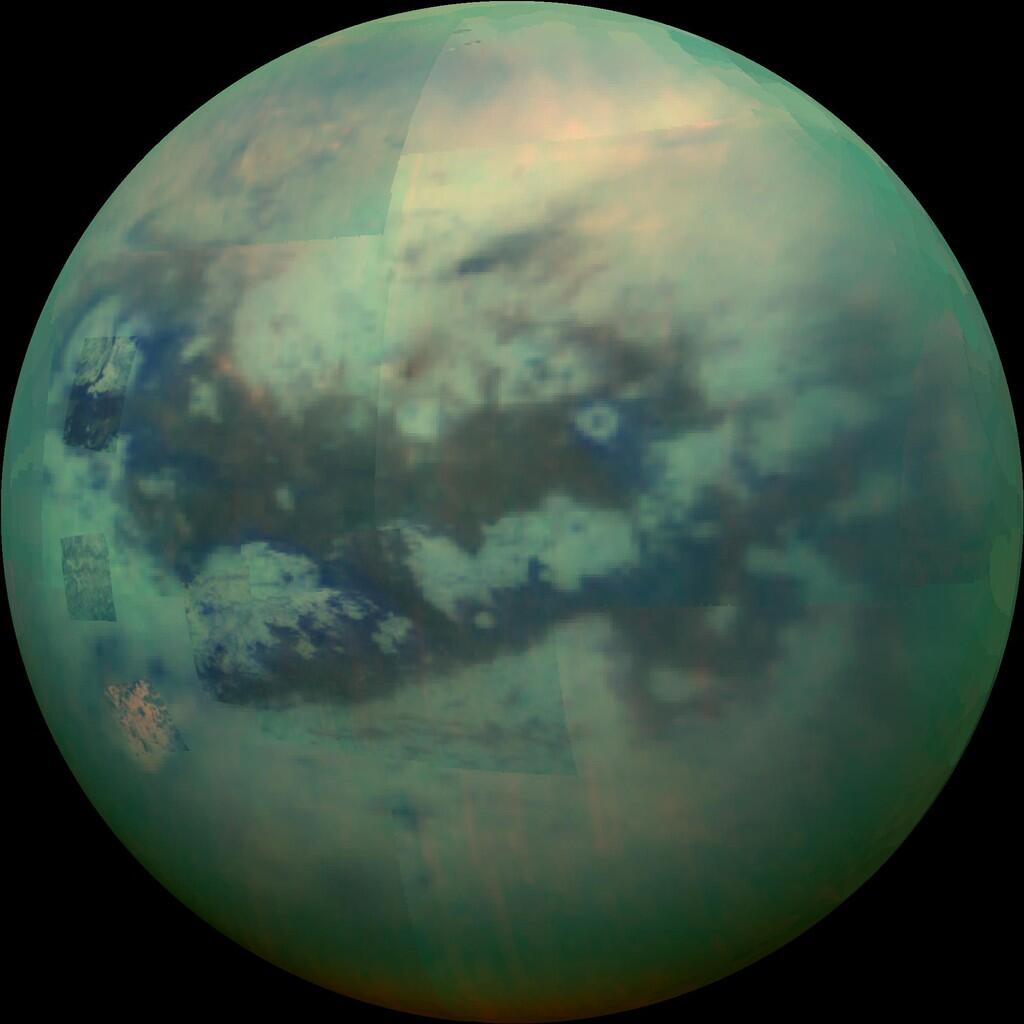
NASA has released a composite image of Saturn's largest moon, Titan, constructed from photos taken by the Cassini spacecraft, that shows the moon's surface instead of its hazy atmosphere.
NASA's website explains the image shows terrain mostly on the Saturn-facing hemisphere of Titan, including the dark, dune-filled regions of Fensal to the north and Aztlan to the south, which together form the shape of a sideways letter H.
Titan is tidal locked, meaning the same side always faces towards Saturn, just as the Moon is tidal locked to Earth.
Cassini flew as close as 10,000 kilometres to the "rich and complex" world of Titan during the November 13 flyby, which was considerably higher than typical flybys at 1,200 kilometres but allowed the spacecraft to capture moderate-resolution views over wide areas, with a resolution of a few kilometres per pixel.
The image, which shows different levels of detail due to the different altitudes the individual pictures were taken from, was taken at near-infrared wavelengths that penetrated the thick orange haze of Titan's atmosphere.
The colours in the image are false and represent the wavelengths of light collected by Cassini's visual and infrared mapping spectrometer (VIMS) instrument, from blue at 1.3 microns, through green at 2.0 microns, to red at 5.0 microns.
Visible light is centred around 0.5 microns.
'Remarkably Earth-like processes'
NASA says images taken by the Cassini orbiter show 'remarkably Earth-like processes' shaping the surface of Titan.
The moon is covered with tall dunes, river channels and great lakes, and is the only moon in our solar system to have a thick atmosphere.
There are relatively few meteorite craters on Titan, meaning that its surface must be relatively young, being reshaped by wind, liquid and tectonic movement similar to processes on Earth.
However, because the surface of Titan is at -179 degrees Celsius, the sand is composed of dark hydrocarbon grains, solid surfaces are water ice as hard as rock, and the liquid present on Titan's surface, in its atmosphere and falling as rain, is methane, which is gaseous on Earth.
Although the atmosphere of Titan is mostly nitrogen (about 95 per cent), most of the remainder is methane, not oxygen.
Methane, a compound of carbon and hydrogen, is broken down by cosmic radiation in Titan's upper atmosphere, contributing to the orange haze that obscures the surface from visible light.
The carbon, hydrogen and nitrogen in Titan's atmosphere result in a range of organic molecules, making it similar to Earth's early atmosphere before life developed.
The Cassini mission is a cooperative project between NASA, the European Space Agency (ESA) and the Italian Space Agency, and is managed through NASA's Jet Propulsion Laboratory (JPL), which designed, developed and assembled the Cassini orbiter and its two onboard cameras.
http://www.abc.net.au/news/2015-12-1...-titan/7015678
NASA's website explains the image shows terrain mostly on the Saturn-facing hemisphere of Titan, including the dark, dune-filled regions of Fensal to the north and Aztlan to the south, which together form the shape of a sideways letter H.
Titan is tidal locked, meaning the same side always faces towards Saturn, just as the Moon is tidal locked to Earth.
Cassini flew as close as 10,000 kilometres to the "rich and complex" world of Titan during the November 13 flyby, which was considerably higher than typical flybys at 1,200 kilometres but allowed the spacecraft to capture moderate-resolution views over wide areas, with a resolution of a few kilometres per pixel.
The image, which shows different levels of detail due to the different altitudes the individual pictures were taken from, was taken at near-infrared wavelengths that penetrated the thick orange haze of Titan's atmosphere.
The colours in the image are false and represent the wavelengths of light collected by Cassini's visual and infrared mapping spectrometer (VIMS) instrument, from blue at 1.3 microns, through green at 2.0 microns, to red at 5.0 microns.
Visible light is centred around 0.5 microns.
'Remarkably Earth-like processes'
NASA says images taken by the Cassini orbiter show 'remarkably Earth-like processes' shaping the surface of Titan.
The moon is covered with tall dunes, river channels and great lakes, and is the only moon in our solar system to have a thick atmosphere.
There are relatively few meteorite craters on Titan, meaning that its surface must be relatively young, being reshaped by wind, liquid and tectonic movement similar to processes on Earth.
However, because the surface of Titan is at -179 degrees Celsius, the sand is composed of dark hydrocarbon grains, solid surfaces are water ice as hard as rock, and the liquid present on Titan's surface, in its atmosphere and falling as rain, is methane, which is gaseous on Earth.
Although the atmosphere of Titan is mostly nitrogen (about 95 per cent), most of the remainder is methane, not oxygen.
Methane, a compound of carbon and hydrogen, is broken down by cosmic radiation in Titan's upper atmosphere, contributing to the orange haze that obscures the surface from visible light.
The carbon, hydrogen and nitrogen in Titan's atmosphere result in a range of organic molecules, making it similar to Earth's early atmosphere before life developed.
The Cassini mission is a cooperative project between NASA, the European Space Agency (ESA) and the Italian Space Agency, and is managed through NASA's Jet Propulsion Laboratory (JPL), which designed, developed and assembled the Cassini orbiter and its two onboard cameras.
http://www.abc.net.au/news/2015-12-1...-titan/7015678
mirip2 permukaan bumi
yang jelas bulan ini blom pernah dibelah

0
1.5K
Kutip
5
Balasan

Komentar yang asik ya
Mari bergabung, dapatkan informasi dan teman baru!

Berita Luar Negeri
82.1KThread•21.1KAnggota
Urutkan
Terlama
Komentar yang asik ya