




TS
kolonel.bejo
“Accidents Involving Nuclear Weapons”
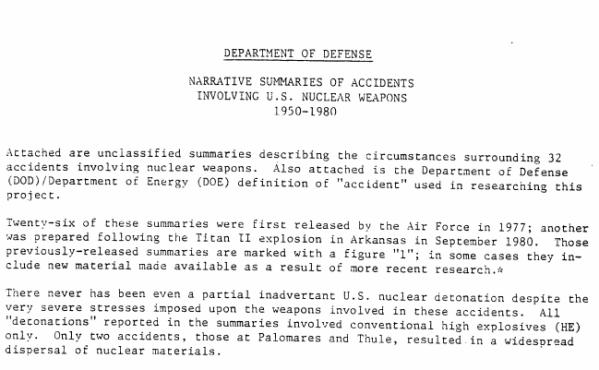
Did the Titan II accident spur some transparency?
According to a Department of Defense report, there have been at least 32 “accidents involving nuclear weapons.” And the report only counts US accidents which occurred before 1980. “Narrative Summaries of Accidents Involving U.S. Nuclear Weapons” briefly recounts each of these incidents. They include such gaffes as nuclear bombs inadvertently falling through bomb bay doors; the accidental firing of a retrorocket on an ICBM; a bomber crash involving the vast dispersal of radioactive debris; and the loss of fissile material and nuclear bombs (which are “still out there somewhere”).
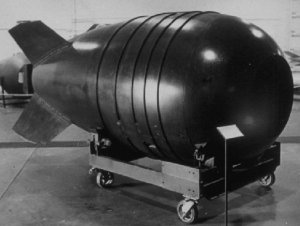
Mark 6 nuclear bomb similar to the one the United States Air Force inadvertently dropped on the Gregg family’s garden in Mars Bluff, South Carolina.
These “nuclear accidents” –which the report defines as “unexpected event[s] involving nuclear weapons or nuclear weapons components”– have occurred over the Pacific Ocean (twice), over the Atlantic Ocean (twice), and over the Mediterranean Sea; they’ve happened on the territory of our allies in Spain, Greenland, England, Morocco, and another undetermined overseas base; and in the states of Arkansas, California (twice), South Carolina, North Carolina, Florida, Georgia, Indiana, Kentucky, Louisiana (twice), Maryland, New Jersey, New Mexico (twice), Ohio (twice), South Dakota, Texas (twice), and Washington.
Some of these accidents were disclosed for the first time only in this report. The DOD explained that these nuclear accidents “may or may not [have been] divulged at the time depending upon the possibility of public hazard or alarm.” Trust me, if I had lived at any of the above locations, I would have preferred that the government “divulge” the fact that a nuclear accident had occurred.
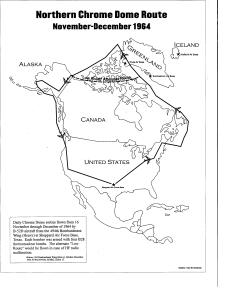
Map of B-52 route flown during Operation Chrome Dome, a facet of Airborne Alert.
According to the DOD’s preface, most of these accidents occurred during “logistic/ferry missions or Airborne Alert flights by Strategic Air Command aircraft.” Airborne Alert was a program in which US nuclear-armed bombers loitered in airspace outside the Soviet Union to ensure that the US could hit the Soviets with a nuclear strike at any time. Airborne Alert was finally terminated in 1968 due to the implementation of ballistic missiles, rising costs, and –not least of all– nuclear accidents, most notably Thule..
This DOD report proudly notes, that “There never has been even a partial inadvertent U.S. nuclear detonation despite the very severe stresses imposed upon the weapons involved in these accidents.” Very fortunate.
At the time of most of these accidents, the primary safeguard against inadvertent detonations was the separate storage of highly enriched fissile material apart from the nuclear bombs themselves. The fissile material had to be manually inserted into the bombs to arm them. Still, there were several accidents where these “nuclear capsules” were either lost or caused the dispersal of substantial amounts of radiation. Although, there were no accidental nuclear explosions, the bombs’ high explosives (a necessary component in nuclear weapons) have detonated several times causing devastation and death.
For a terrific, in-depth, and comprehensive analysis of each of these accidents, I recommend reading the blow-by-blow critique presented in The Defense Monitor. Here are a couple of the DOD report’s cold-sweat-inducing lowlights, several also highlighted by Schlosser:
In 1957 a nuclear bomb fell through the bomb bay doors of a B-36 bomber near Kirkland Air Force Base, New Mexico. The bomb fell 1,700 feet to the ground and its high explosives detonated, showering fragments as far as one mile from the impact point.
In 1958 a B-47 “accidentally jettisoned an unarmed nuclear weapon” which fell and detonated on a garden owned by the Gregg family in Mars Bluff, South Carolina. The high explosive detonation created a crater 50-70 feet wide and 25-30 feet deep. The Gregg family’s home was completely destroyed (the DOD report recounted only “property damage”); five other homes and a church were also damaged. Fortunately, members of the Gregg family received only minor injuries. (Here is some incredible newsreel footage of the aftermath.) (Update: I’ve learned the site is now a roadside tourist attraction.)
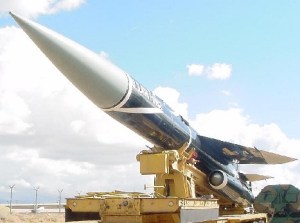
A BOMARC A air defense missile.
In 1960 a 47-foot-long BOMARC air defense missile (which could be readied to launch within minutes) caught fire at McGuire Air Force Base near Trenton, New Jersey. According to the New York Times, the missile “melted under an intense blaze fed by its 100-pound detonator of TNT… The atomic warhead apparently dropped into the molten mass that was left of the missile, which burned for forty-five minutes.” The DOD report was less descriptive, stating merely that “nuclear safety devices acted as designed.”
In 1961 a B-52 carrying two 24 megaton nuclear weapons (equivalent to 3,700 “Hiroshima bombs”) broke up in the air over Goldsboro, North Carolina. One bomb fell as far as 10,000 feet and sunk into the “waterlogged farmland.” The Air Force dug as deep as 50 feet trying to excavate the weapon, which contained uranium, but was unsuccessful. Finally, the Air Force purchased an easement on the land. Reportedly, a Pentagon document stated that five of the bomb’s six safety mechanisms had failed; “only a single switch” prevented the nuclear detonation of this 24 megaton device. (Here’s the DOE document behind Schlosser’s most recent account.)
In 1966 a B-52 carrying four nuclear weapons crashed into a KC-135 aircraft over Palomares, Spain. Two of the bombs did not explode and were eventually recovered after a search described as “the most expensive, intensive, harrowing and feverish underwater search for a man-made object in world history.” Two of the bombs’ high explosive material exploded on impact with the ground. The explosion –though conventional– released substantial amounts of radioactive materials. 1400 tons of soil and vegetation were eventually removed and transported to the United States.
And here is the report’s description of the Titan II accident Schlosser’s account is centered upon
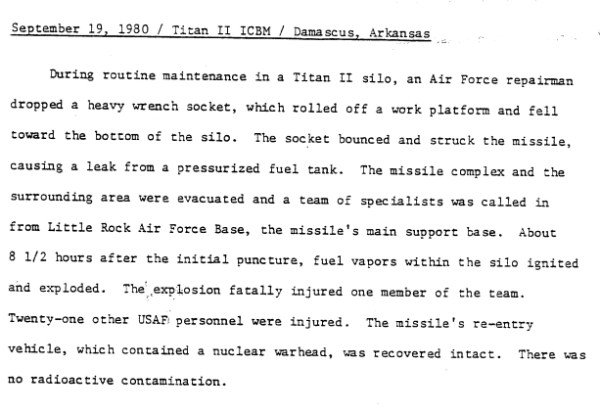
….”dropped a heavy wrench socket.”
This small sampling of harrowing accounts clearly chinks the counter-intuitive and commonly argued position that nuclear weapons actually make the world a safer place. It reminds us that the shattering blast and fiery rain of a nuclear detonation may not occur because of war, terrorism, or miscalculation, but rather, because of something more common: an “accident.”
https://nsarchive.wordpress.com/2013...clear-weapons/
0
2.5K
4
Thread Digembok
Mari bergabung, dapatkan informasi dan teman baru!

Militer
20.4KThread•10.9KAnggota
Urutkan
Terlama
Thread Digembok